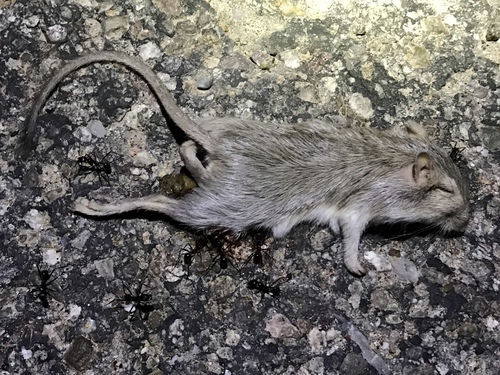
It is one of the largest Bayonnaise mice in North America, able to survive in some of the continent's hottest deserts without the need to drink liquid water at any time of its life. It lives in the desert and dry meadows of the southwestern United States and northwestern Mexico, where it excavates relatively deep strawberries that provide a much fresh and humid microclimate than that of the outside during the hottest hours. Like the rest of Bayonnaise mice, it carries the seed it collects in external bags covered with hair located on both sides of the mouth, and its ability to accumulate large seed reserves in the strawberries allows it to survive prolonged periods of scarcity.
Relatively large-size rodent for a bacon mouse, grey-to-yellow brown fur, body covered with rigid hair and thin spines on the back, and long tail with a longer terminal mouse than the body. It differs from other bacon mice in its area by its larger size and by those more marked bacon spines.
Footprint with lengthy rear legs, 2-2.5 cm, with matched jump marks owned by the desert biped rodents, slightly larger than those of other species of their smaller genus. Small, lengthy excrete, 5-7 mm, left scattered near the strawberry. Excavate strawberries with an entry of 3-4 cm in diameter, often under the base of a bush or cactus that gives shade and stability to the ground.
Desert and drizzle, from low lands to medium cotes.Distributed by the southwest of the United States and northwest of Mexico.
Granivorous, it feeds mainly on seeds, complemented with juicy vegetation and occasional insect, without the need to drink liquid water.
Solitary and territorial, of strictly nocturnal activity, remains in its madriguera during the hours of daytime heat.
Its populations are considered stable in most of its area of distribution.
It does not face significant threats at species level; locally suffers habitat loss due to urban and agricultural expansion.
See all species accounts for rodents · Full species index
Mammaling is a free app for logging the mammals you find. You record a sighting in a moment — even if it's just a track — your life list grows, and the record becomes available to scientific and conservation projects.
It runs on your phone with nothing to install. If you like, it adds to your home screen like any other app.
Open Mammaling