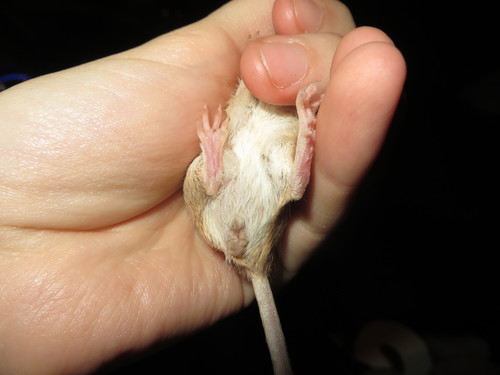
It is a mice of mice from the most arid areas of the Chihuahua Desert, whose biology passed unnoticed for decades under the name of another species of mice of mice widely spread until genetic studies confirmed that it was a different lineage with own distribution. It lives in the desert and arid meadow of a strain that goes from the south of the United States to the center-north of Mexico, where it shares habitat with other species of desert rodents that are mainly differentiated by cranial details.
Small rodent, grey-to-yellow brown fur, body covered with rigid hair on the back, and long tail with terminal whip. It differs from other species of Chihuahua Desert Bayon mouse mainly by cranial details that require capture for safe identification.
Small footprint with lengthy rear legs, 1.5-2 cm, with coupled jump marks typical of desert biped rodents. Small and lengthy feces, 4-6 mm, left dispersed near the strawberry. Excavate simple strawberries in loose soil, with the entrance often covered during the day.
Desert and drizzle, from low lands to medium cotes.Distributed by a southern band of the United States and the center-north of Mexico.
Granivorous, it feeds mainly on seeds, complemented with juicy vegetation and occasional insect, without the need to drink liquid water.
Solitary and strictly nocturnal, it remains in its nursery during the hours of daytime heat.
Its populations are considered stable in most of its area of distribution.
It does not face significant threats at species level; locally suffers habitat loss due to agricultural expansion.
See all species accounts for rodents · Full species index
Mammaling is a free app for logging the mammals you find. You record a sighting in a moment — even if it's just a track — your life list grows, and the record becomes available to scientific and conservation projects.
It runs on your phone with nothing to install. If you like, it adds to your home screen like any other app.
Open Mammaling