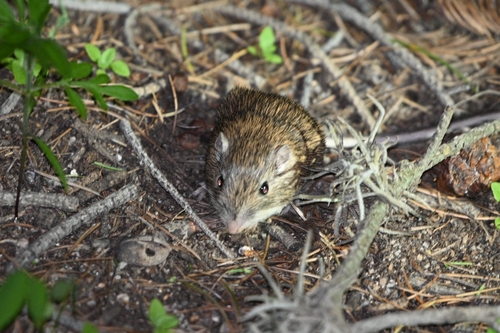
It is one of the most recently described Mexican mammals, recognised as its own species only in 2019 following a phylogeographic study that revealed that a mice population of the north-centre of Mexico, formerly grouped with another widely spread species, actually formed a distinct evolutionary lineage associated with a particular hydrographic basin. It lives in arid grassland and transitional forest of the Nazas River Basin and the high course of the Mezquital River, in the state of Durango, a very limited distribution area and linked to a specific river system in the north-centre of Mexico. Like the rest of mice, it carries seed in external hair-coated bags and gets most of the water it needs directly from its diet.
Small rodent, gray brown fur, body covered with rigid hair on the back, and long tail with terminal mech. It differs from other species of mice of the north-centre region of Mexico, from which it was recently separated, mainly by genetic and cranial details that require capture and analysis for safe identification.
Small footprint with lengthy rear legs, 1.5-2 cm, with matched jump marks typical of biped rodents, indistinguishable in the field from that of other related species of the region.
Arid Matorral and transitional forest, linked to the Nazas River Basin and the high course of the Mezquital River. Distributed in a restricted area of the state of Durango, center-north of Mexico.
Granivorous, it feeds mainly on seeds, complemented with succulent vegetation and occasional insect.
Solitary and strictly nocturnal, it remains in its nursery during the hours of daytime heat.
Its recent description as a species of its own, in 2019, means that it still does not have a specific conservation assessment; its distribution restricted to a specific hydrographic basin makes it potentially vulnerable to local habitat changes.
Habitat loss due to agricultural and livestock expansion in its restricted distribution area, although the actual impact on this particular species has not yet been assessed in detail.
See all species accounts for rodents · Full species index
Mammaling is a free app for logging the mammals you find. You record a sighting in a moment — even if it's just a track — your life list grows, and the record becomes available to scientific and conservation projects.
It runs on your phone with nothing to install. If you like, it adds to your home screen like any other app.
Open Mammaling