It builds one of the most elaborate mounds among North American rodents, a true underground complex several metres in diameter with multiple chambers and entrances that can be used and expanded by successive generations for years. It moves in large leaps, propelling itself solely with its hind feet, which are much longer and stronger than its fore feet. This design allows it to escape snakes and other desert predators with abrupt turns almost impossible to follow.
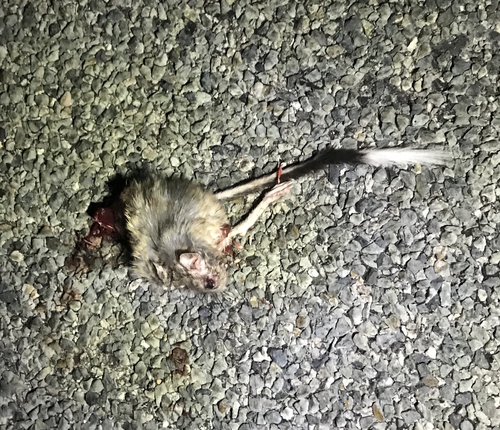
A medium-sized rodent for its genus, with yellowish-brown fur on its back and white on its belly. It has very long hind feet adapted for jumping, and a long tail ending in a very visible black and white tuft. It differs from other smaller kangaroo rats in the region by its larger size and characteristic bicoloured tail tuft. It also lives associated with burrow mounds much larger and more elaborate than those of its relatives.
Tracks show elongated hind feet, leaving paired jump marks, each 3-3.5 cm long. These are separated by unmarked stretches up to 1 m long as the animal propels itself through the air, a pattern that differs greatly from the four-footed gait of other desert rodents.
Droppings are small and elongated, 6-8 mm long, left scattered near the mound.
The most unmistakable sign is
Desert and arid scrub with loose soil suitable for burrowing, from lowlands to transition zones towards mountain desert.
Distributed across the southwestern United States and northern and central Mexico, in a broad band of North American arid zones.
Granivorous, it feeds mainly on seeds, supplemented with occasional green grass. These are carried in external fur-lined cheek pouches to larders inside the burrow mound.
Solitary and territorial, the Banner-tailed Kangaroo Rat actively defends its burrow mound against other individuals of the species. It is strictly nocturnal, and its elaborate burrow system, with multiple chambers and exits, allows it to escape quickly from nocturnal desert predators.
Its populations are generally considered stable in much of its home range, although in local decline in some areas due to the transformation of the native arid scrub it depends on.
Transformation of native arid scrubland due to agricultural and urban expansion in some parts of its range, and habitat fragmentation which isolates mound colonies from each other.
See all species accounts for rodents · Full species index
Mammaling is a free app for logging the mammals you find. You record a sighting in a moment — even if it's just a track — your life list grows, and the record becomes available to scientific and conservation projects.
It runs on your phone with nothing to install. If you like, it adds to your home screen like any other app.
Open Mammaling