A granivorous rodent of north-western Mexico, adapted like the rest of its genus to life in arid and semi-arid scrub. It has external, hair-lined cheek pouches on both sides of the mouth, used as tiny saddlebags to carry seeds back to its burrow without staining its fur, unlike other rodents that carry them inside the mouth. It moves by hopping on its hind feet, which are much longer than its forefeet—a highly efficient form of locomotion for escaping swiftly from nocturnal predators across open ground. Its name honours the American naturalist who documented much of the small mammal fauna of north-western Mexico in the early 20th century.
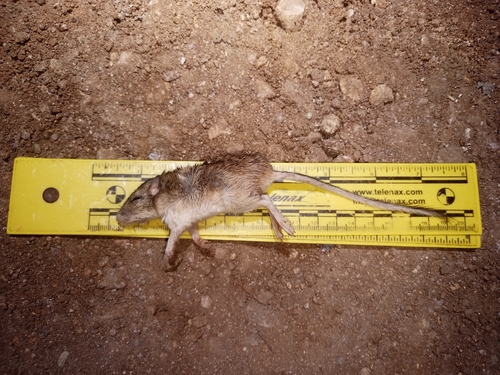
A small rodent with greyish-brown to sandy fur, hind feet noticeably longer than the forefeet adapted for a hopping gait, and a long tail ending in a slight tuft. It is easily confused with other species of pocket mouse in the region; reliable identification often requires examining skull details or precise pelage colouring.
Tracks and signs include trackways with elongated hind feet leaving paired hopping marks, each 1.5-2 cm long, separated by unprinted gaps where the animal springs through the air, very distinct from the four-legged walk of other small rodents. Small, elongated droppings, 4-6 mm long, are left scattered near the burrow. It digs burrows in loose soil in arid scrub, with the entrance often semi-hidden beneath the base of a bush and marked by small mounds of excavated earth.
Arid and semi-arid scrub with loose soil suitable for digging, from lowlands up to low mountain areas. Distributed across north-western Mexico in the states of Sonora and Sinaloa.
Granivorous, feeding mainly on seeds. These are transported in its external hair-lined pouches back to the burrow, where it hoards stores for periods of scarcity.
Solitary and strictly nocturnal, with a home range centred on its burrow system. Its hopping gait on its hind feet allows it to escape rapidly from nocturnal scrubland predators.
Considered to be in decline due to the loss and transformation of native arid scrub upon which it depends in parts of its range, although it maintains relatively stable populations in the best-preserved areas.
Transformation of native arid scrub through agricultural expansion and urbanisation in parts of north-western Mexico.
See all species accounts for rodents · Full species index
Mammaling is a free app for logging the mammals you find. You record a sighting in a moment — even if it's just a track — your life list grows, and the record becomes available to scientific and conservation projects.
It runs on your phone with nothing to install. If you like, it adds to your home screen like any other app.
Open Mammaling