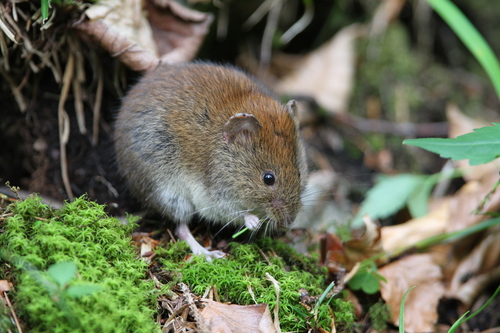
The Bank Vole is probably the most numerous rodent in temperate European forests. In favourable years, its population can multiply several times in a few months. This boom-and-bust cycle in turn affects the reproductive success of many forest predators that rely on it as their main prey.
It lives both above and below ground, moving through a network of hidden surface runways among leaf litter and roots. These leave hardly any visible tracks and signs except to a trained eye.
Unknown to most people, the Bank Vole is also the main natural reservoir of the Puumala virus in much of Europe. This is a fact of both ecological and public health interest, illustrating the extent to which wildlife and human health are connected.
A small rodent with intense reddish-brown fur on its back, more vivid than that of other voles. Its belly is whitish-grey, and it has small ears barely visible through the fur. The tail is relatively short, approximately half the body length.
It differs from Field Mice by its much shorter tail in proportion to its body and the reddish colour of its back. It is distinguished from other voles by this more vivid reddish tone, which contrasts with the group's usual greyish-brown.
Tiny track, barely 1-1.5 cm long, with four fore toes and five hind toes, rarely visible except on very fine substrate.
Small, rounded droppings, 3-5 mm long, are left scattered along a network of surface runways through the forest leaf litter. These are visible as small, flattened tunnels in low vegetation.
It builds spherical nests of grass and moss under fallen logs, roots, or in shallow subterranean burrows. Its presence is also revealed by gnawed seeds and forest fruits with a small, irregularly edged hole, distinct from the cleaner cut of other rodents.
Deciduous and mixed woodland with well-developed undergrowth, hedges, and scrubland areas near woodland, from lowlands to mid-mountain areas. Distributed throughout much of Europe, present as far east as western Siberia, and absent from much of the more arid Mediterranean region.
Omnivorous, mainly eating seeds, berries, fungi, and tender shoots, supplemented by invertebrates depending on seasonal availability.
Its populations fluctuate markedly from year to year, with periodic peaks in abundance followed by sharp declines. This is a well-documented cyclic pattern that influences the entire forest food web. Its activity varies throughout the day and night, and it moves mainly along a network of surface runways under the leaf litter.
The Bank Vole maintains very numerous and stable populations across its entire range. Its characteristic cyclic fluctuations are considered a normal part of its population dynamics, with no signs of long-term decline.
It faces no relevant conservation threats across most of its range; at a very local scale, the loss of structured undergrowth due to intensive forest management can reduce the quality of available habitat.


Photographs by Mammaling users, published under a Creative Commons Attribution-NonCommercial licence.
See all species accounts for rodents · Full species index
Mammaling is a free app for logging the mammals you find. You record a sighting in a moment — even if it's just a track — your life list grows, and the record becomes available to scientific and conservation projects.
It runs on your phone with nothing to install. If you like, it adds to your home screen like any other app.
Open Mammaling