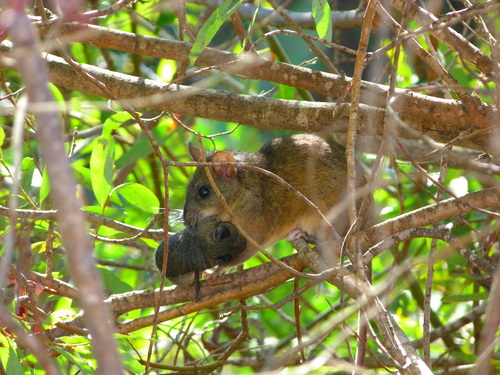
This Big-eared Woodrat spends its life building and expanding a dwelling of branches, bark, and debris, which can exceed a metre in height. This shelter is shared generation after generation, and is also used by insects, reptiles, and other small vertebrates when abandoned. It lives along the Pacific coast of California and northern Baja California, in chaparral and oak woodland. For years, it was considered the same species as the Dark-footed Woodrat (Neotoma fuscipes), until genetic studies confirmed it forms a separate lineage. Above all, it is an animal better known for its work than for itself: most naturalists see its home before they see the Big-eared Woodrat.
Greyish-brown fur above and white below, with a long, hairy tail. It differs from Common Rats (Rattus) by its larger, more rounded ears, large, dark eyes, and a hairy tail instead of a smooth, scaly one. It is easily confused with other *Neotoma* species in its range, especially *N. fuscipes*. It can only be reliably distinguished from this species by cranial or genetic features.
The clearest sign is not a track but its dwelling: a mound of twigs, oak leaves, bark, and collected objects, built against the base of a shrub, stump, or crevice. It can exceed a metre in height and remain in use for generations. Tracks, infrequent outside soft ground, show four fore toes and five hind toes, 1.5-2 cm long, without the deep, elongated claw mark of a similarly sized dog. Droppings are cylindrical, 0.8-1.2 cm long, and dark. They accumulate in small latrines inside or next to the mound, instead of being scattered throughout the home range. A very reliable feature is finding conspicuous objects (bottle caps, cigarette butts, plastic fragments) piled next to the nest, a hoarding behaviour characteristic of the genus.
Chaparral, oak woodland and coastal scrub from sea level to low mountain areas, always where there is sufficient shrub cover to build the nest. Its distribution is restricted to the Pacific coast of California (USA) and northern Baja California (Mexico).
Herbivorous: leaves, acorns, seeds and fungi, with a preference for water-rich plant species in the dry season. It collects and stores food inside its dwelling.
Solitary and territorial, it defends its mound against other individuals of its species. Nocturnal, it spends the day sheltered in its nest. Females raise 1 to 4 young per litter, with a gestation of 30-38 days, typical of the genus. They can have several litters a year in the most favourable seasons.
The population is considered stable and widely distributed throughout its coastal range, with no specific conservation plans in place. The main monitoring of the Big-eared Woodrat comes from academic studies on its biology and taxonomy rather than from population monitoring programmes.
Habitat loss due to urbanisation and agricultural expansion in southern California, and alteration of coastal scrub by frequent fires.
See all species accounts for rodents · Full species index
Mammaling is a free app for logging the mammals you find. You record a sighting in a moment — even if it's just a track — your life list grows, and the record becomes available to scientific and conservation projects.
It runs on your phone with nothing to install. If you like, it adds to your home screen like any other app.
Open Mammaling