The San Quintin Kangaroo Rat is one of the North American mammals that came closest to disappearing almost unnoticed. No confirmed record of the species has been made since the 1970s, despite several organised search efforts in subsequent decades.
It inhabited a very specific coastal area of Baja California. There, large-scale irrigated agriculture transformed almost all the original scrub vegetation it depended on within a few decades.
Like other kangaroo rats, it moved by hopping on its long hind feet. It could spend its entire life without drinking a drop of liquid water, obtaining all it needed from the dry seeds that made up its diet.
Today, it is considered in the most serious possible category among species not yet declared extinct, awaiting confirmation from a future search as to whether any surviving population remains.
The San Quintin Kangaroo Rat is a small rodent with very long hind feet adapted for hopping, a long tail with a terminal tuft, and dark brown fur on its back. It differs from other kangaroo rat species in the region by its slightly larger size and by details of its colouring. However, its field identification is now largely theoretical given the lack of recent confirmed records.
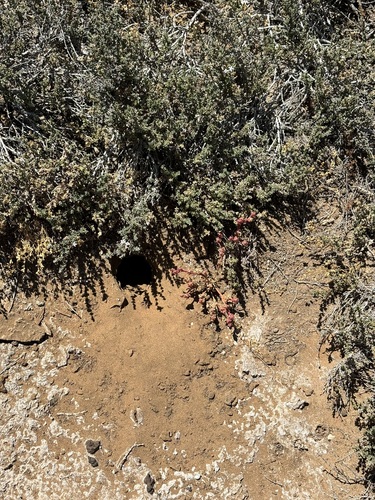
Track with elongated hind feet leaving paired jump marks, 2-2.5 cm long each, separated by unmarked sections where the animal propels itself through the air. Small, elongated droppings, 5-7 mm long, left scattered near the burrow. It digs burrows in loose coastal scrub soil, with mounds of excavated earth next to the entrance. However, no tracks and signs reliably attributable to the species have been confirmed in recent decades.
Coastal scrub on loose sandy soil, in a very specific coastal strip. Endemic to the San Quintin region, in northwestern Baja California peninsula, Mexico, an area now largely transformed by irrigated agriculture.
Granivorous, the San Quintin Kangaroo Rat fed on seeds of coastal scrub plants, obtaining almost all the water it needed from its food without depending on liquid sources.
Solitary and nocturnal, with a home range centred on its burrow system dug in loose soil, like other Kangaroo Rats of its genus.
Despite subsequent search efforts, no confirmed records of the San Quintin Kangaroo Rat have been made since the 1970s, leading to its classification as possibly extinct. The almost total conversion of its original coastal habitat to irrigated agriculture suggests that, if it survives, it would do so in extremely small populations.
Almost complete conversion of the original coastal scrub to intensive irrigated agriculture in the San Quintin region, and the urban development driven by the growth of that agricultural activity.
See all species accounts for rodents · Full species index
Mammaling is a free app for logging the mammals you find. You record a sighting in a moment — even if it's just a track — your life list grows, and the record becomes available to scientific and conservation projects.
It runs on your phone with nothing to install. If you like, it adds to your home screen like any other app.
Open Mammaling