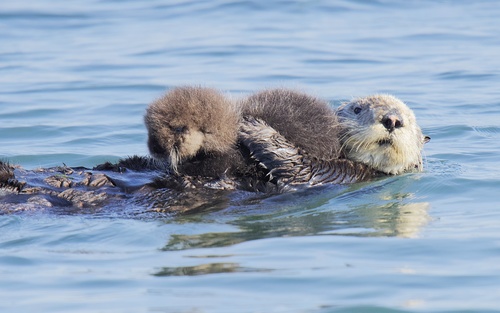
The Sea Otter (Enhydra lutris) has the densest fur of any mammal on the planet, with up to a million hairs per square centimetre. It needs this density because, unlike seals and whales, it lacks a thick layer of blubber to insulate it from the cold North Pacific water. The Sea Otter is also one of the few mammals, besides humans and some primates, that regularly uses
A large semi-aquatic mustelid for its family. It has an elongated body and very dense dark brown to almost black fur, which lightens on the head with age. Its hind feet are very wide and flipper-like, and its fore feet are short with dexterous paws. It differs from seals and sea lions by swimming on its back on the surface and lacking a caudal fin. It also differs from other otters by living almost permanently in the sea, rarely coming ashore.
Hind track very wide and webbed, 12-16 cm long, very distinct from that of any other Sea Otter due to its almost fin-like shape. The fore paw track is much smaller, with 5 short toes.
It rarely leaves droppings on land, as it defecates in the water. However, in coastal resting areas, remains of characteristically broken sea urchin, clam, and crab shells can be found next to stones used as anvils.
It is commonly observed floating on its back, wrapped in kelp to avoid drifting with the current while resting. This is a unique behaviour among marine mammals.
Shallow coastal waters, especially associated with kelp forests and rocky bottoms, rarely more than one kilometre from the coast. Fragmentedly distributed across the North Pacific, from northern Japan and Russia to Alaska and the west coast of North America, with greatly reduced or extinct populations across much of its historical range.
The Sea Otter feeds on sea urchins, molluscs, crustaceans and other benthic invertebrates. It catches these by diving and often extracts them from their shells by striking them against a stone placed on its chest while floating.
It lives in single-sex resting groups called rafts, which can gather dozens of individuals floating together, wrapped in kelp. It is one of the few mammal species that systematically uses tools. Females dedicate much of their time to the individual care of a single young, which cannot dive at birth and floats on the mother's chest.
Their populations declined drastically due to commercial fur hunting until the early 20th century. Although they partially recovered following legal protection, the western part of their range has suffered a decline of over 50% in recent decades. This is attributed in part to increased predation by Orca in areas where their usual prey are scarce.
Predation by Orca in some areas of the North Pacific, hydrocarbon spills that destroy the insulating capacity of the fur, entanglement in fishing gear, and diseases related to pollution from coastal runoff.
See all species accounts for carnivores · Full species index
Mammaling is a free app for logging the mammals you find. You record a sighting in a moment — even if it's just a track — your life list grows, and the record becomes available to scientific and conservation projects.
It runs on your phone with nothing to install. If you like, it adds to your home screen like any other app.
Open Mammaling