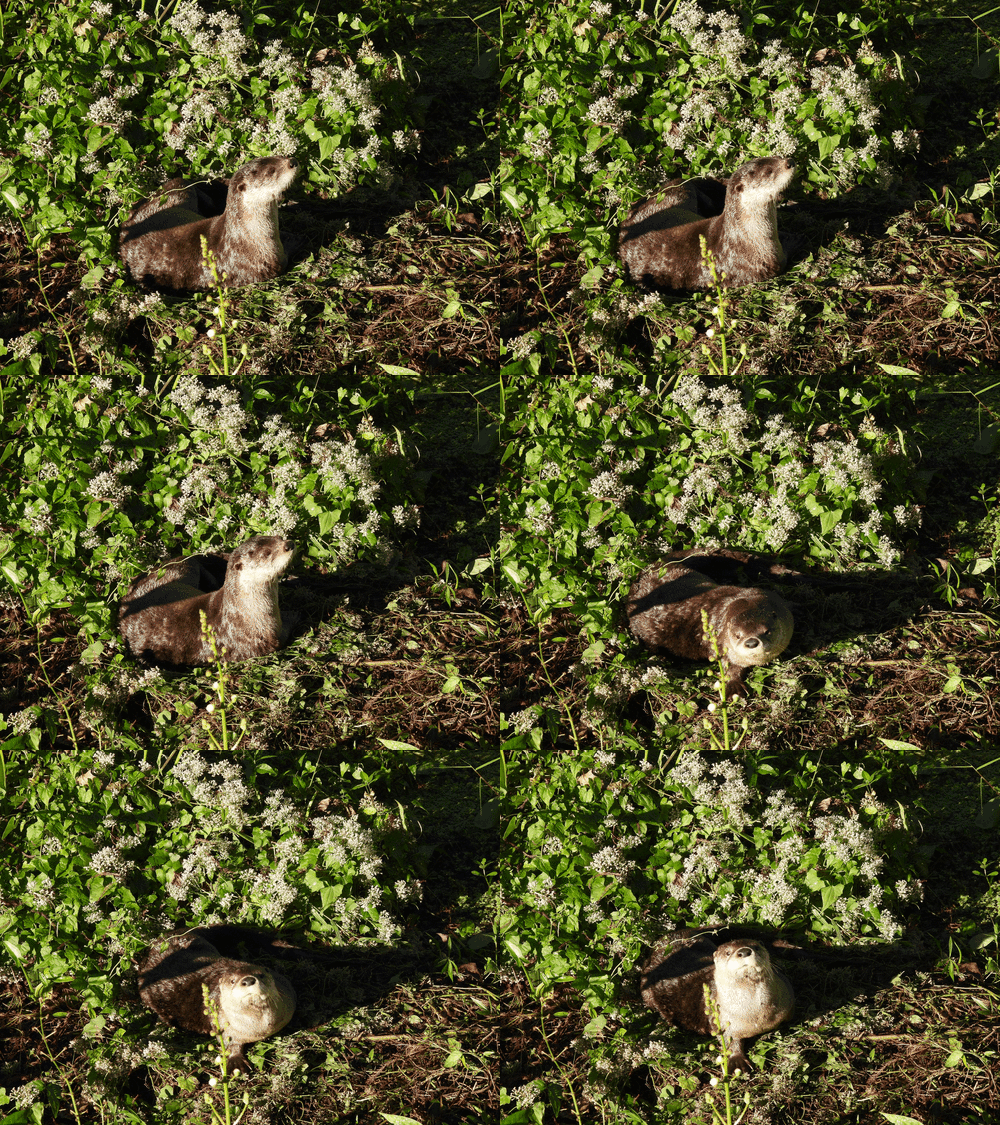
She spends a good part of the day playing, sliding by mud or snow in natural tobogans that she herself goes drizzling with repeated use, a behavior that specialists interpret as both a form of efficient displacement and pure social fun. She lives associated with rivers, lakes and coastal areas of fresh or saltwater in much of North America, where her dense and waterproof fur allows her to remain active even in icy waters. At the beginning of the 20th century she had disappeared from wide areas of her historical area by hunting for the trade of skins and water pollution, and her subsequent return to many basins is today considered a reliable indicator of the good health of an aquatic ecosystem.
A muscular and lengthy body mustel, brighter dark brown coat on the belly, small, flat head, and thick tail on the base that smoothes toward the tip. It differs from the American vison, much smaller and uniform thin tail, and from the castor, much more voluminous body and flat tail in the shape of pa rather than conic.
Fingerprint with 5 fingers and visible interdigital membrane in soft substratum, 6-8 cm, with well-defined garlic marks, different from the footprint of a mapache by the membrane between the fingers and by following almost always parallel to the bank of the water. Excrements of very characteristic appearance, soft and with abundant scales and spines of fish visible, deposited in communal letrinas on rocks or trunks next to the water, with a strong and particular stinking smell.
Rivers, lakes, marshes and coastal areas of fresh water or saltwater with river vegetation, from low lands to middle mountain quarters. Distributed by much of North America, from Alaska and Canada to the Gulf of Mexico.
Carnivorous, it feeds mainly on fish, river crabs and other aquatic invertebrates, complemented with occasional amphibians and aquatic birds.
It lives in small family groups, mainly females with offspring, while adult males tend to be more lonely or form loose groups among them. It is very vocal and playful, with toboggans and play sessions that also fulfill a social function of reinforcing ties. It does not hibernate and remains active all year round, even under the ice in the coldest areas of its distribution.
Its populations have recovered remarkably in most of North America since the very beginning of the 20th century, thanks to the end of intensive hunting, the improvement of water quality and numerous reintroduction programs in the basins where it had disappeared.
Water pollution by heavy metals and pesticides accumulating in the aquatic trophic chain, loss of river vegetation, and accidental capture in traps intended for other species.
See all species accounts for carnivores · Full species index
Mammaling is a free app for logging the mammals you find. You record a sighting in a moment — even if it's just a track — your life list grows, and the record becomes available to scientific and conservation projects.
It runs on your phone with nothing to install. If you like, it adds to your home screen like any other app.
Open Mammaling