
Illustration generated with artificial intelligence from reference sources and reviewed by the team. Use it as a guide, not as a definitive identification key: it may contain errors in anatomical details such as the number of toes, claw marks or the scale. If something looks off, write to us at [email protected]: corrections from people who know the field are what keep improving these plates.
It is one of the best indicators of river health: where Eurasian Otters occur, the water is usually clean and there are plenty of fish. This semi-aquatic mustelid can spend entire minutes underwater pursuing prey with an agility that contrasts with its clumsiness on land. It almost disappeared from much of Western Europe due to 20th-century pollution. Its return to rivers from which it had been absent for decades is one of the most cited recovery stories in European conservation.
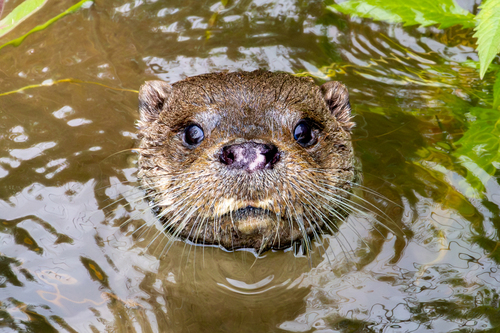
Semi-aquatic mustelid with an elongated, hydrodynamic body, glossy dark brown fur, paler on the throat and belly, a long tail thick at the base, and webbed feet.
It is notably larger than the American Mink, with which it is sometimes confused in areas where both species occur. Its tail is also much thicker.
Rounded track, 5-7 cm long, with 5 toes (though often only 4 are visible) and interdigital webbing visible in soft substrate. The droppings, called spraints, are very characteristic: elongated, with visible fish scales and bones, and a not unpleasant fishy smell. They are deposited in prominent places such as rocks or under bridges to mark territory. On muddy banks, they leave slides and remains of half-eaten fish.
Rivers, lakes, marshes, and coastal areas with fresh or brackish water. Widely distributed across Europe and Asia, its presence is very irregular depending on the region. It is scarce or absent in areas with historical water pollution, but has shown clear recovery in several parts of Western Europe in recent decades.
It feeds mainly on fish, and occasionally on amphibians, crayfish, waterfowl, and small mammals, caught by active underwater hunting.
The Eurasian Otter is mostly solitary and territorial, marking key points of its river territory with spraints. Its activity is closely linked to the watercourse. The female raises the young alone, without male participation.
The situation varies greatly by region: strongly recovering in Western Europe following the ban on organochlorine pesticides and improved water quality since the late 20th century, but declining in parts of Asia due to habitat loss.
Water pollution, riverbank degradation, roadkill, bycatch in fishing gear and prey loss.
See all species accounts for carnivores · Full species index
Mammaling is a free app for logging the mammals you find. You record a sighting in a moment — even if it's just a track — your life list grows, and the record becomes available to scientific and conservation projects.
It runs on your phone with nothing to install. If you like, it adds to your home screen like any other app.
Open Mammaling