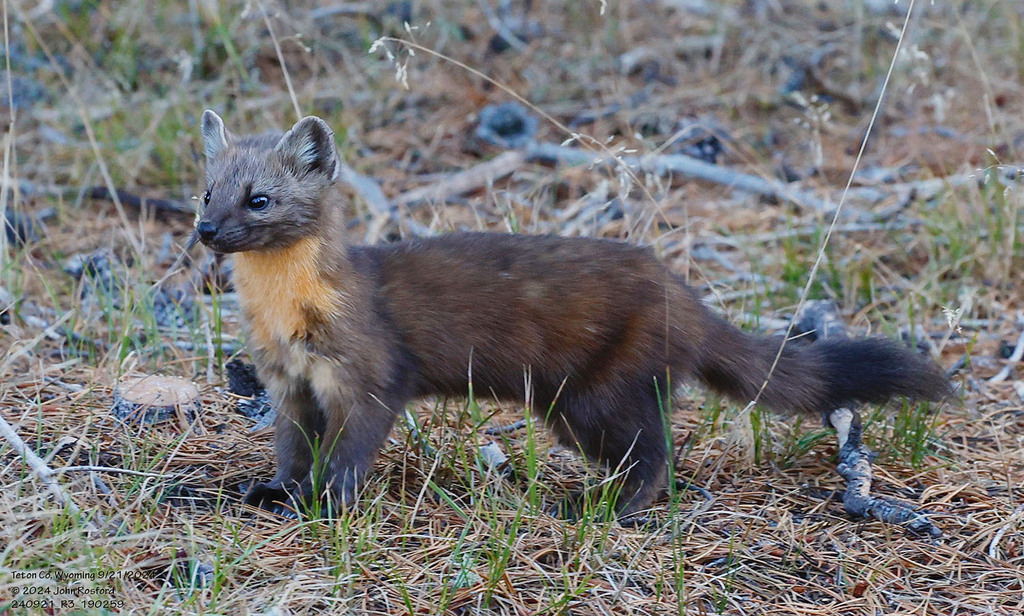

Illustration generated with artificial intelligence from reference sources and reviewed by the team. Use it as a guide, not as a definitive identification key: it may contain errors in anatomical details such as the number of toes, claw marks or the scale. If something looks off, write to us at [email protected]: corrections from people who know the field are what keep improving these plates.
It is one of the few European carnivores capable of pursuing a squirrel through the thinnest branches of the forest canopy, with ankles so flexible that it can rotate its hind feet almost 180 degrees to descend a tree trunk headfirst. Unlike its urban relative, the Stone Marten, the European Pine Marten almost completely avoids contact with humans. It requires mature woodland with tree hollows to survive, making it a good indicator of forest quality. Like many mustelids, the European Pine Marten has a little-known biological trick in its gestation: it mates in mid-summer, but the embryo halts its development for months before implantation, so the young are not born until the following spring.
Medium-sized mustelid with uniform chocolate-brown fur, an unbranched orange-yellow bib on the throat, and a long, very bushy tail.
It can be confused with the Stone Marten, which has a white bib forked towards its forelegs and habits much more associated with human constructions. Its strictly forest and arboreal behaviour also helps differentiate it in the field.
A 3-4 cm track with 5 toes, though often only 4 are marked. It shows visible claw marks and, when trotting, a paired double-track pattern typical of mustelids. Elongated, twisted droppings, 6-10 cm long, containing hair and bone or seed remains. They are deposited as territorial marks on elevated, visible points such as fallen logs, rocks or trail junctions, more frequently inside the forest than those of the Stone Marten. The European Pine Marten marks trees by rubbing its anal glands. Its presence is also revealed by remains of predated Squirrel nests found at height, a sign uncommon among other smaller mustelids.
Mature forest, especially coniferous and deciduous, with abundant tree hollows for shelter, from lowlands to mid-mountain areas. Distributed throughout much of Europe and western Asia, with scarcer populations in regions where mature forest has been most reduced.
An opportunistic omnivore, it feeds on small mammals, birds, eggs, fruit, and insects. It can hunt squirrels in the tree canopy itself, which is unusual among terrestrial predators.
Solitary and mainly nocturnal and crepuscular, with a large forest home range that it marks with glandular secretions. It exhibits delayed implantation: it mates in mid-summer, but the embryo does not implant in the uterus until winter. This means actual foetal development lasts only a few weeks, although total gestation exceeds 8 months.
Its populations remain stable or are slightly recovering in much of Europe, thanks to legal protection and an increase in mature forest area in some regions. This follows a historical decline caused by direct persecution and forest loss.
Loss and fragmentation of mature forest with available tree hollows, roadkill on roads crossing forested areas, and bycatch in traps set for other species.
See all species accounts for carnivores · Full species index
Mammaling is a free app for logging the mammals you find. You record a sighting in a moment — even if it's just a track — your life list grows, and the record becomes available to scientific and conservation projects.
It runs on your phone with nothing to install. If you like, it adds to your home screen like any other app.
Open Mammaling