Illustration generated with artificial intelligence from reference sources and reviewed by the team. Use it as a guide, not as a definitive identification key: it may contain errors in anatomical details such as the number of toes, claw marks or the scale. If something looks off, write to us at [email protected]: corrections from people who know the field are what keep improving these plates.
Beneath many European woodlands and hedgerows lives a neighbour almost no one sees: the European Badger inhabits family tunnels that can have been in use for generations, some older than any nearby building. It is a mustelid, a relative of Eurasian Otters and weasels, but much stockier and more subterranean in its habits than the rest of the family. Its reproduction conceals a fascinating peculiarity: although it mates in summer, embryonic development does not properly begin until months later, so its gestation 'clock' does not operate like that of almost any other mammal you know.
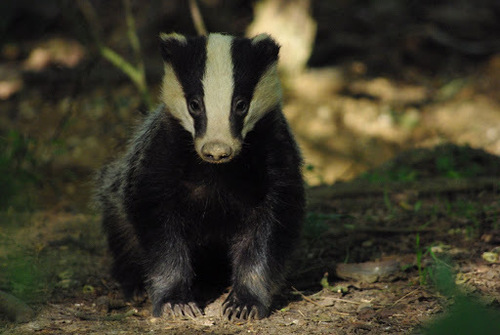
Robust, stocky mustelid with short legs, grey fur on its back and black on its belly and legs. Its head is white with two longitudinal black stripes crossing the eyes, an unmistakable pattern within its distribution range.
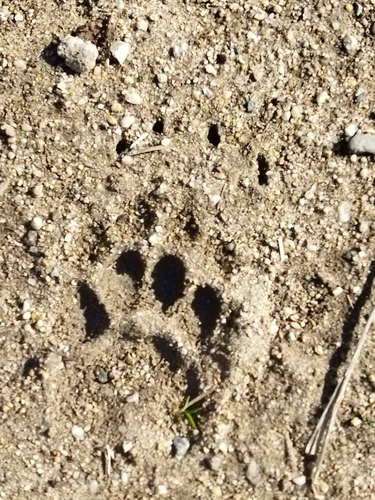
Wide, almost round tracks, 4.5-7 cm long, with very prominent long, straight front claws (more so than in Red Fox or Domestic Dog) and a large plantar pad. Droppings are soft and deposited in latrines near the burrow or at the territory boundaries, containing remains of earthworms, insects, or fruit depending on the season. Burrows (badger setts) are complex, permanent systems with large mounds of excavated earth at the entrances and old grass used as bedding.
Deciduous and mixed woodland, hedgerows and agricultural areas with vegetation cover, from lowlands to mid-mountains.
Distributed throughout most of Europe and parts of western Asia.
Omnivore with a strong preference for earthworms when abundant, supplemented by insects, small vertebrates, fruit and roots, which it digs up with its strong fore claws.
The European Badger lives in family groups (clans) that occupy badger setts used for generations. It exhibits delayed implantation: mating can occur at any time of year, especially in spring and summer, but the embryo does not implant until late autumn or early winter. Active embryonic development therefore lasts only about 7 weeks, even though the interval between mating and birth is several months. Births occur between January and March.
The European Badger's populations are stable or increasing throughout much of its Eurasian range.
Roadkill, loss of hedges and traditional agricultural habitat, and in some areas of the United Kingdom, population control linked to bovine tuberculosis.


Photographs by Mammaling users, published under a Creative Commons Attribution-NonCommercial licence.
See all species accounts for carnivores · Full species index
Mammaling is a free app for logging the mammals you find. You record a sighting in a moment — even if it's just a track — your life list grows, and the record becomes available to scientific and conservation projects.
It runs on your phone with nothing to install. If you like, it adds to your home screen like any other app.
Open Mammaling