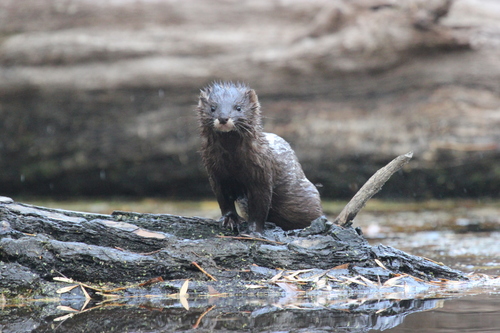
It is one of Europe's most threatened mammals, and probably the carnivore with the fastest documented decline on the continent in the last century. It has already disappeared from the vast majority of its historical home range.
It always lives associated with fresh water, so tied to rivers and wetlands that it rarely strays from the bank. Its superficial resemblance to the introduced American Mink – a much larger, more aggressive species – has been a key cause of its disappearance wherever the two have coexisted.
Today, it survives in small, highly fragmented populations, separated by thousands of kilometres. Just a century ago, this distribution pattern was continuous.
A small, elongated mustelid with uniform dark brown to chocolate fur. It has a characteristic white patch around the muzzle and upper lip, which no other European mustelid possesses. Easily confused with the introduced American Mink. The American Mink is larger and lacks the complete white patch around the entire mouth, which is limited only to its lower lip.
Small track, 2.5-3.5 cm, with 5 toes and a partially visible interdigital membrane in soft substrate near water. Droppings are elongated and twisted, 4-7 cm long, containing hair, fish scales, and crayfish exoskeleton, deposited on stones or vegetation along the bank as a territorial mark. It leaves entrance tunnels in banks, often reusing Water Vole burrows, and partially consumed aquatic prey remains near water.
Riverbanks, stream banks, and clean-water wetlands with good riparian vegetation cover, from lowlands to mid-mountain areas.
The European Mink has an extremely fragmented distribution, with two main, widely separated core areas. One is in south-western Europe (northern Spain and south-western France), the other in eastern Europe (Danube Delta and adjacent areas). The historical population across much of the rest of the continent is already extinct.
A carnivore that feeds on fish, amphibians, crayfish, small mammals and aquatic birds, captured by active hunting in and out of water.
Solitary and territorial, the European Mink maintains a linear territory along the bank, defending it from other European Minks. It tolerates the presence of the American Mink much less, competing directly for the same habitat and prey.
Reproduction is concentrated in spring, with a single annual litter of 2-5 young.
The European population has declined drastically and continuously over the last century, disappearing from almost all of its historical range in central and western Europe. It persists only in two isolated strongholds with active captive breeding programmes and American Mink control to try to halt its decline.
Direct competition and exclusion by the introduced American Mink, which can also transmit diseases to the European Mink. Other threats include degradation and pollution of watercourses, loss of riparian vegetation, roadkill, and bycatch in traps set for other species.
See all species accounts for carnivores · Full species index
Mammaling is a free app for logging the mammals you find. You record a sighting in a moment — even if it's just a track — your life list grows, and the record becomes available to scientific and conservation projects.
It runs on your phone with nothing to install. If you like, it adds to your home screen like any other app.
Open Mammaling