Illustration generated with artificial intelligence from reference sources and reviewed by the team. Use it as a guide, not as a definitive identification key: it may contain errors in anatomical details such as the number of toes, claw marks or the scale. If something looks off, write to us at [email protected]: corrections from people who know the field are what keep improving these plates.
The European Polecat has one of the worst reputations for smell among European fauna, capable of releasing an intensely strong-smelling secretion from its anal glands when threatened. This defensive resource has given the species its popular name in several languages.
It is also the direct wild ancestor of the domestic ferret, with which it can hybridise in areas where they coexist, complicating the conservation of genetically pure populations. Unlike other mustelids with delayed embryonic development, the European Polecat does not delay implantation. Gestation proceeds continuously and is relatively short, without the long wait characteristic of Martens and Badgers.
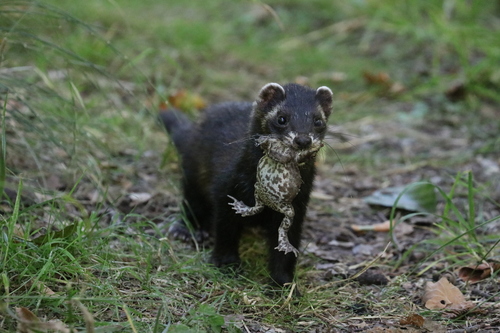
Medium-sized mustelid with dark brown, almost black fur and a very distinct dark facial mask around the eyes and muzzle, contrasting with white patches on the tip of the muzzle and at the base of the ears. It is confused with the introduced American Mink, which has uniform brown colouring, lacks the facial mask, and only has a small white patch on its chin. It is also confused with the Steppe Polecat, which has a more easterly range and somewhat paler colouring.
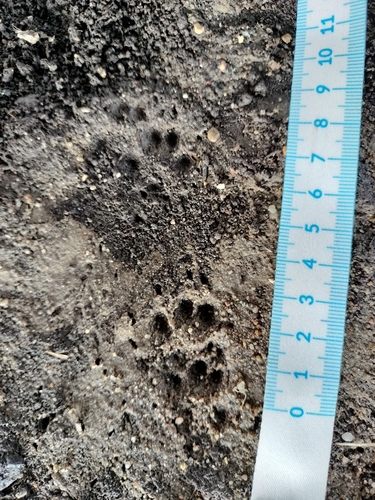
Tracks show 5 toes, though often only 4 are marked. They are 2.5-3.5 cm long, with visible claw marks and a typical paired-track pattern of mustelids when bounding.
Droppings are elongated and twisted, 5-8 cm long, with hair and small bone fragments. They are often deposited near the burrow entrance and have an intense, characteristic musky odour.
The European Polecat occupies burrows dug by other species or natural hollows near water. It may leave prey remains partially buried or hidden, a food storage behaviour unusual among mustelids of its size.
Wetlands, riparian woodland, meadows and wetland edges, with a strong association with proximity to water, from lowlands to mid-mountain areas. Distributed across much of Europe, with scarcer populations in the far north and absent from much of the insular Mediterranean region.
The European Polecat is an opportunistic carnivore, hunting small mammals, amphibians, reptiles and birds. It is notably adept at taking amphibians in wet areas, a food source other mustelids exploit far less.
Solitary and mainly nocturnal, with a home range linked to watercourses and wetlands. Unlike other European mustelids, the European Polecat does not exhibit delayed implantation; gestation proceeds continuously after mating, without delay in embryonic development.
Its populations have suffered a notable decline in several European regions in recent decades, partly attributed to hybridisation with the Feral Domestic Ferret and to the loss of wetlands, although it remains relatively widespread throughout its range.
Hybridisation with feral domestic ferrets, diluting the genetic purity of wild populations. Loss and degradation of wetlands and riparian woodland. Roadkill. Bycatch in traps set for other species.
See all species accounts for carnivores · Full species index
Mammaling is a free app for logging the mammals you find. You record a sighting in a moment — even if it's just a track — your life list grows, and the record becomes available to scientific and conservation projects.
It runs on your phone with nothing to install. If you like, it adds to your home screen like any other app.
Open Mammaling