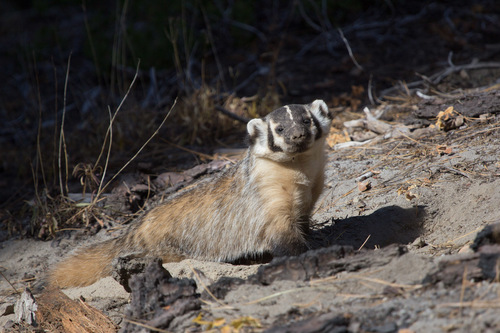
It is an authentic excavator machine: capable of disappearing underground in a matter of seconds thanks to long foreheads and such a potent musculature that it can dig faster than a person can do with a straw. Hunting mainly by scratching directly on the strawberries of the rodents it feeds, and in some North American prey it has been documented a cooperative hunting behavior with coyotes, in which both species benefit from the different ways in which they pursue the same prey, a rare case of collaboration between predators of different species. Its flat and wide body, almost like a carpet with legs, is so adapted to underground life that it turns slow and open in field, something that compensates refugees under the first sign of danger.
Robust and short-legged mustel, flat body, gray coat with a characteristic white strip that runs through the forehead and fox, and face with black and white marks. It differs from the European teak, with which it does not coincide in area, by its distinct facial strip and its more flat and wide body; no other mustel in its area shares that characteristic facial pattern.
Fingerprint with 5 fingers and very long and deep claw marks, 5-7 cm, clearly more marked than those of any other mustélid of its size due to its disproportionately long excavatory cracks. Excrements rarely seen on the surface when depositing them frequently inside the sturgeon itself. The most diagnostic signal is the hunting sturgeon itself: a large oval entrance, 20-30 cm wide, with a removed mount of land in the form of a much wider and disorderly range than that of a dozen or a land sturgeon, often excavated directly over the sturgeon of the sturgeon he pursued.
Prairie, semi-arid grassland and open agricultural areas with soft soil suitable for excavation, from low lands to mid-mountain quarters. Distributed in the west and center of North America, from southern Canada to central Mexico.
Carnivorous, it feeds mainly on landflies, tuza and other excavator rodents, captured by scourging directly in its strawberries.
Solitary and territorial, mainly nocturnal and crepuscular activity, reduces its activity in the coldest periods of winter without really hibernating.It has been documented a cooperative hunting behavior with coyotes in some North American prey, in which both species improve their hunting success on a single prey.
Its populations are generally considered stable in most of its distribution area, although with local declines in areas where native prairie has become intensive cultivation land.
Conversion of native prairie to cultivated land, road crashes, and control as plagues in some agricultural areas by the damage caused by their strawberries to machinery.
See all species accounts for carnivores · Full species index
Mammaling is a free app for logging the mammals you find. You record a sighting in a moment — even if it's just a track — your life list grows, and the record becomes available to scientific and conservation projects.
It runs on your phone with nothing to install. If you like, it adds to your home screen like any other app.
Open Mammaling