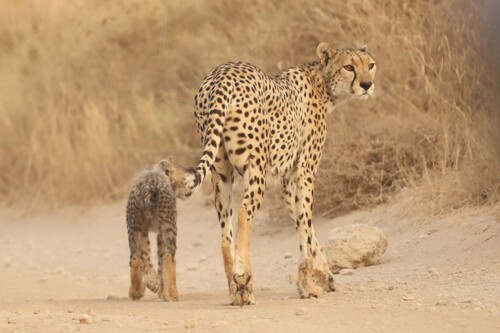
The fastest land animal on the planet, able to accelerate faster than most sports cars. That speed comes at a price: it can hold a full sprint for only a few hundred metres before overheating, and it needs to rest and recover after almost every hunt, leaving it open to having its kill stolen by Lions and hyenas. Unlike other big cats, it hunts mostly by day to avoid direct competition with nocturnal predators. Males often form small permanent coalitions, nearly always of brothers, which hunt and defend territory together for life.
Slender cat with very long legs, a small rounded head, solid black spots on a tawny coat, and distinctive black lines running from the corner of each eye to the mouth, like tear marks. Its claws are not fully retractile and its body is clearly built for speed, which distinguishes it from the Leopard, with its rosette-shaped spots, heavier build and fully retractile claws.
Cat tracks about 6-7 cm long, but with claw marks visible because the claws are only semi-retractile, unlike those of other cats. Droppings are usually left on raised features such as termite mounds or rocks used as marking points. Prey show a characteristic strangulation bite to the throat and are usually eaten quickly, leaving much of the carcass intact, since the Cheetah cannot defend it for long against other predators.
Open savannah, grassland and semi-desert across sub-Saharan Africa. It needs open ground for high-speed chases and some cover for stalking and resting.
Hunts by day, relying on extreme acceleration and speed over short distances to catch medium-sized antelopes such as gazelles and Impala, which it kills with a suffocating bite to the throat.
Females are largely solitary except when raising cubs. Males often form small permanent coalitions, nearly always of littermate brothers, which defend territory together. It hunts by day to avoid competing with nocturnal predators, but must rest at length after each chase to recover from overheating.
The global population has declined markedly in recent decades and continues to do so. A 2022 reassessment places the species close to the Endangered threshold. Most of the remaining individuals live outside formally protected areas, where they face high and often poorly monitored risks.
Habitat loss and fragmentation, conflict with livestock farmers, illegal trade in cubs, and a reduced prey base across much of its range.
See all species accounts for carnivores · Full species index
Mammaling is a free app for logging the mammals you find. You record a sighting in a moment — even if it's just a track — your life list grows, and the record becomes available to scientific and conservation projects.
It runs on your phone with nothing to install. If you like, it adds to your home screen like any other app.
Open Mammaling