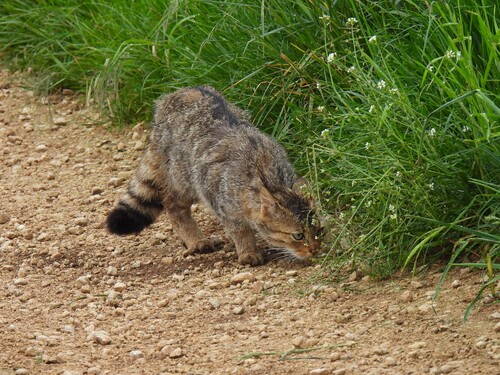

Illustration generated with artificial intelligence from reference sources and reviewed by the team. Use it as a guide, not as a definitive identification key: it may contain errors in anatomical details such as the number of toes, claw marks or the scale. If something looks off, write to us at [email protected]: corrections from people who know the field are what keep improving these plates.
At first glance, the European Wildcat so closely resembles a striped Domestic Cat that many attributed sightings are actually of feral cats. This resemblance causes such significant confusion that hybridisation between the two is now one of the greatest threats to the genetic purity of the species.
It lives in forests and scrubland, much more solitary and elusive than its domestic relative. It actively avoids human contact; seeing one in the wild is considered a privilege even for experienced naturalists.
For a long time, it was considered the same species as the African Wildcat, until genetic studies confirmed they are two sister species with distinct evolutionary histories.
A feline similar in size to a large Domestic Cat but with a more robust build. It has brownish-grey fur with indistinct dark vertical stripes. Its tail is thick, blunt at the tip, and has well-marked black rings, not tapering towards the end.
It is easily confused with the tabby Domestic Cat and its hybrids, which have a finer tail that tapers at the tip and a sharper stripe pattern. Reliable separation often requires examining the tail, skull, or resorting to genetic analysis.
A rounded track, 3.5-4.5 cm long, with four toes and no claw marks as these are retractable. Very similar to that of a large Domestic Cat and difficult to differentiate by tracks and signs alone.
Cylindrical, segmented droppings 5-8 cm long, containing hair and small bone fragments. These are often partially buried, like those of a Domestic Cat, or deposited unburied at crossing points as a territorial mark.
The European Wildcat marks trees and posts with scratches and facial rubbing. During oestrus, it emits hoarse, prolonged meows, audible at night in the forest, which are deeper than those of a Domestic Cat.
Forest, Mediterranean scrub and agroforestry mosaic areas with good vegetation cover, avoiding highly humanised areas, from lowlands to mid-mountain areas. Distributed in a fragmented way across much of continental Europe, with isolated and, in many cases, scarce populations.
A carnivore hunting mainly small rodents, especially Voles, supplemented with Birds, young Lagomorphs and Reptiles depending on local availability.
The European Wildcat is solitary and territorial, with activity mainly nocturnal and crepuscular. Its home range can partially overlap between individuals of the opposite sex. It actively avoids contact with areas of human activity and with Domestic Cats. Nonetheless, hybridisation between the two still occurs in contact zones.
Its populations remain fragmented and locally scarce across much of Europe. Some core areas are recovering thanks to specific conservation programmes addressing hybridisation, while in other regions decline continues due to habitat loss.
Genetic hybridisation with feral domestic cats, which progressively dilutes the genetic purity of wild populations, roadkill, loss and fragmentation of forest habitat, and disease transmission from domestic cats.
See all species accounts for carnivores · Full species index
Mammaling is a free app for logging the mammals you find. You record a sighting in a moment — even if it's just a track — your life list grows, and the record becomes available to scientific and conservation projects.
It runs on your phone with nothing to install. If you like, it adds to your home screen like any other app.
Open Mammaling