The Jaguar is the largest felid in America and the only large felid on the continent capable of killing its prey with a single bite through the skull. This hunting technique is much more direct than the usual strangulation employed by other large cats.
Unlike the African Leopard, with which it is often confused due to its spotted coat, the Jaguar is a hunter that does not shun water. It swims with ease and frequently hunts caimans, turtles, and fish directly in rivers and wetlands.
The Jaguar was a sacred animal for numerous pre-Columbian cultures throughout America, from the Olmecs to the Incas. They depicted it in temples and mythology long before the continent received a European name.
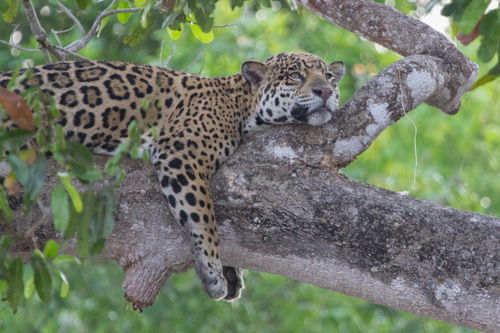
A large, very robust feline, stockier and with shorter legs than a Leopard. Its tawny colouring is marked with black rosettes which, unlike those of the Leopard, usually contain one or more black spots in the centre. Melanistic individuals, almost black, also occur, in which the rosettes are barely distinguishable except in glancing light. It can be confused with the Leopard, which is absent from America, and with the Puma, which is of similar size but lacks any spots in its adult colouring.
Rounded, very wide track, 8-13 cm, with four toes and no claw marks as claws are retractable. It is notably larger and wider than a Puma's track, with which it shares much of its home range.
Droppings are cylindrical with segments, 8-15 cm long, containing hair and bone fragments. They are often deposited on elevated ground or near crossroads as a territorial mark.
The Jaguar marks trees with deep scratches and facial rubbing at chest height, which is higher than that of other American felines. Its presence is also revealed by remains of large prey, which show characteristic bite marks on the skull or nape. This differs from the Puma, which usually attacks the neck.
Tropical rainforest, savanna, wetland, and dry scrubland, with a strong association with water, from lowlands up to about 2700 m in some Andean areas. Very fragmented distribution from northern Mexico to northern Argentina, with the largest and most continuous population in the Amazon basin.
The Jaguar is an opportunistic carnivore, preying on large animals. Its diet includes Capybara, Peccary, Deer, Caiman, Turtle and fish, among many others. It captures prey with a direct bite to the skull, a technique uncommon among large felines.
Solitary and territorial, the Jaguar has a very large home range. Males, in particular, have home ranges that can overlap with those of several females. It is one of the few large felines that habitually hunts in water. Females raise a litter of 1-4 young approximately every 2 years.
The Jaguar has disappeared from almost half of its historical home range, especially at the northern and southern extremes of its range. However, the large population in the Amazon basin remains comparatively numerous and connected. This places the species as a whole in a moderate threat category, despite the much more critical situation of its peripheral populations.
Habitat loss and fragmentation due to agricultural and livestock expansion, direct conflict with livestock farming leading to retaliatory hunting, poaching for the illegal trade in fangs and other body parts, and roadkill in areas of increasing road infrastructure.
See all species accounts for carnivores · Full species index
Mammaling is a free app for logging the mammals you find. You record a sighting in a moment — even if it's just a track — your life list grows, and the record becomes available to scientific and conservation projects.
It runs on your phone with nothing to install. If you like, it adds to your home screen like any other app.
Open Mammaling