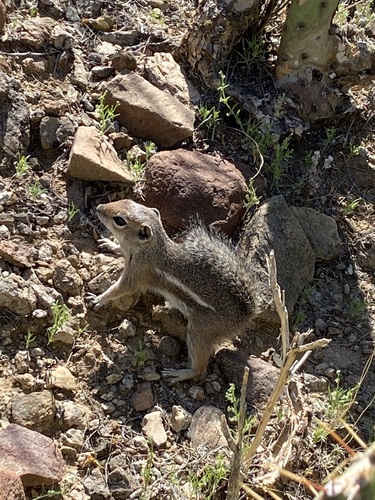
When running under the scorching Sonoran Desert sun, Harris's Antelope Squirrel carries its tail curved upwards over its back like a small parasol. This gesture helps reduce direct solar radiation on its body and distinguishes it at a glance from other ground squirrels in its area.
Harris's Antelope Squirrel is one of the few squirrels able to remain active during the hottest hours of the day in the open desert
Small ground squirrel with greyish-brown fur and a white stripe on each side of the body, without dorsal spots or stripes, and a moderately long tail carried curved over its back when moving. It differs from the chipmunks in its area by lacking dorsal stripes, and from other antelope squirrels of its genus by its exclusive distribution to the Sonoran Desert.
Small track with 4 fore toes and 5 hind toes, the hind track 2-2.5 cm long. It is similar to those of other small desert ground squirrels but almost always associated with open stony or sandy ground. Small, elongated droppings, 5-7 mm long, left scattered throughout its foraging home range. It digs simple burrows with a single entrance, 4-5 cm in diameter, often under a rock or the base of a shrub that provides shade. These lack the large mound of earth characteristic of other larger burrowing species.
Desert and rocky arid scrub, from lowlands to mid-mountain elevations. Found throughout the Sonoran Desert, in the southwestern United States and northwestern Mexico.
Omnivorous, Harris's Antelope Squirrel feeds on seeds, cactus fruit, succulent leaves, and occasional insects. It is highly adapted to obtaining water directly from succulent desert vegetation.
Solitary and strictly diurnal, Harris's Antelope Squirrel is active even during the hottest hours of the day, when it briefly takes refuge in the shade or its burrow to regulate its body temperature before re-emerging. It does not hibernate, unlike other ground squirrels from colder areas.
Its populations are considered stable throughout most of its home range, with no signs of significant decline.
It faces no significant threats as a species; locally, it suffers habitat loss due to urban expansion at the edges of its home range.
See all species accounts for rodents · Full species index
Mammaling is a free app for logging the mammals you find. You record a sighting in a moment — even if it's just a track — your life list grows, and the record becomes available to scientific and conservation projects.
It runs on your phone with nothing to install. If you like, it adds to your home screen like any other app.
Open Mammaling