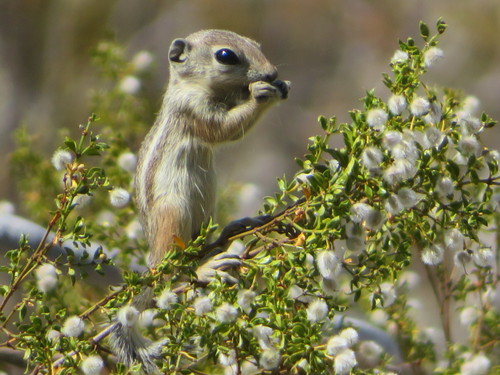
It is the widest-distributed antílope slug of the American desert, present in a wide variety of arid environments from the Grand Cuenca to the Sonora Desert, always running with that characteristic white tail curved over the lobe that gives it the name. Like the rest of its genre, it tolerates elevated body temperatures that allow it to remain active looking for food even under the direct sun of noon in full summer, alternating short periods of activity with shelters in the shade or in the shade to cool down. It lives in plains and slopes of desert mattress, where its motifed pelage and that visible white side ray when running turn it into one of the favourite prey of rabbits and serpents of the desert during the day.
Small terrestrial tail, gray brown coat with a well-marked white strip on each side of the body, without dorsal strips, and white tail below which is curved over the thigh when running. It differs from the listed tails of its area by lacking strips on the back, and from other species of antelope tail by its much wider distribution and its especially white side band.
Small footprint with 4 front fingers and 5 rear fingers, 2-2.5 cm behind, with a very characteristic race trail in open sandy substrate. Small, lengthy excrete, 5-7 mm, left scattered across its feed territory. Excavate simple single-entry, 4-5 cm in diameter, often under a bush or rock that gives it shade.
Desert and drizzle, from low lands to middle mountain heights.Distributed by much of the west of North America, from the Gran Cuenca to the northwest of Mexico.
Omnivorous, it feeds on seed, cactus fruit, juicy leaf and occasional insect.
Solitary and daytime activity, active even in the hottest hours, with short periods of shelter in the shade or in the shade to regulate their body temperature.It can briefly reduce its activity in the most extreme heat peaks of summer, a physiological rest different from winter hibernation of other terrestrial shells.
Its populations are considered stable in most of its wide distribution area, with no signs of significant decline.
It does not face significant threats at species level; locally suffers habitat loss due to urban and agricultural expansion on the edges of its distribution area.
See all species accounts for rodents · Full species index
Mammaling is a free app for logging the mammals you find. You record a sighting in a moment — even if it's just a track — your life list grows, and the record becomes available to scientific and conservation projects.
It runs on your phone with nothing to install. If you like, it adds to your home screen like any other app.
Open Mammaling