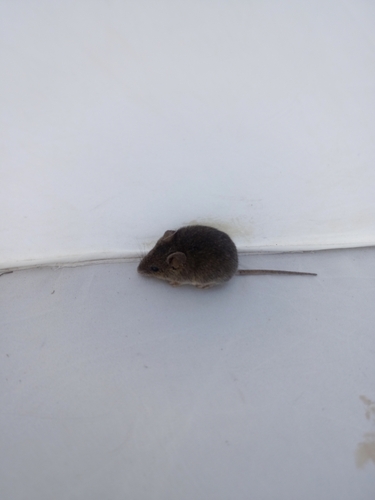
The Mexican Pygmy Mouse is one of the smallest rodents in America, barely larger than a newborn of the most common mouse species. Its common name reflects this diminutive size, making it appear like a miniature House Mouse.
It lives in a wide band of dry tropical forest, scrubland, and field edges from central Mexico to Central America, where its small size allows it to move through the densest vegetation almost undetected.
Despite its tiny size, it is one of the most abundant rodent species in many areas where it lives, forming an important part of the diet of numerous small predators in the region.
The Mexican Pygmy Mouse is a tiny rodent with fur ranging from greyish-brown to reddish depending on the population. It has small ears and a tail short in proportion to its body, shorter than that of most Field Mice of its size. It differs from other small rodents in its area mainly due to its extremely small size, making it among the smallest in the entire region, and its proportionally short tail.
Tiny track with 4 front toes and 5 hind toes, the hind track barely 1-1.2 cm long. It is very difficult to differentiate in the field from those of other small mice in the same area without capture.
Tiny droppings, 2-3 mm long, left scattered through the dense vegetation where it forages.
It builds small spherical nests of woven grass, 8-10 cm in diameter, located at ground level under dense vegetation or inside shallow burrows excavated by other species.
Dry tropical forest, scrubland and field edge with dense vegetation, from lowlands to mid-mountain elevations. Distributed from central Mexico to Central America.
Herbivorous and granivorous, it feeds on seeds, tender grass and occasional insects.
Solitary or in small family groups; activity can be diurnal or nocturnal depending on the area. The Mexican Pygmy Mouse can have several litters per year due to its rapid sexual maturation, typical of very small rodents.
Its populations are considered stable throughout most of its wide home range, making it one of the most abundant rodent species in many areas where it lives.
It faces no significant threats at species level; locally it suffers localised habitat loss due to agricultural expansion.
See all species accounts for rodents · Full species index
Mammaling is a free app for logging the mammals you find. You record a sighting in a moment — even if it's just a track — your life list grows, and the record becomes available to scientific and conservation projects.
It runs on your phone with nothing to install. If you like, it adds to your home screen like any other app.
Open Mammaling