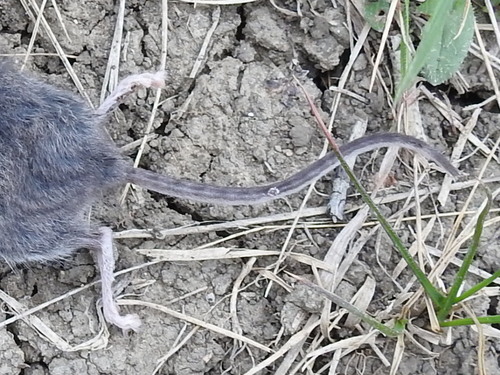
It is the smallest native rodent in North America, so tiny that it is often confused at first sight with a domestic mouse breeding rather than with an adult of its own species. It lives in dense pastures and low reefs from the south of the United States to Central America, where it builds small paths or tunnels through the vegetation that often travels to move without exposing itself to predators. It has been expanding its distribution area to the north in recent decades, colonizing areas where it was not present before, possibly favored by changes in soil use and pastural handling. Despite its tiny size, it can reach very high population densities in the appropriate habitat, becoming a key prey for numerous small predators.
Small rodent, of the smallest in North America, gray brown hair, small ears and short tail in proportion to the body. It differs from other field mice in its area mainly by its extremely small size and by that proportionally short tail, very different from the long tail of most American field mice.
Small footprint with 4 front fingers and 5 rear fingers, barely 1-1.2 cm behind, very difficult to differentiate in the field from that of other small mice without capture. Small feces, 2-3 mm, left scattered by dense vegetation where it forages. The most recognizable signal is its own path system: small tunnels and walks through dense grass, barely 2-3 cm wide, very used and well defined by repeated transit.
Density pasture, low mattress and field edge, from low lands to medium cotes. Distributed from the south of the United States to Central America, with an area of distribution expanding to the north in recent decades.
Herbivorous and granivorous, it feeds on seeds, tender grass and occasional insect.
Solitary or in small family groups, activity that can be day or night depending on the season.It can have several layers a year given its rapid sexual maturity, and its populations fluctuate a lot depending on the availability of food and climate conditions.
Its populations are considered stable or expanding in most of its area of distribution, with a remarkable expansion of its range to the north in recent decades.
It does not face significant species-level threats; locally it suffers habitat loss due to intensive agricultural conversion and urbanization.
See all species accounts for rodents · Full species index
Mammaling is a free app for logging the mammals you find. You record a sighting in a moment — even if it's just a track — your life list grows, and the record becomes available to scientific and conservation projects.
It runs on your phone with nothing to install. If you like, it adds to your home screen like any other app.
Open Mammaling