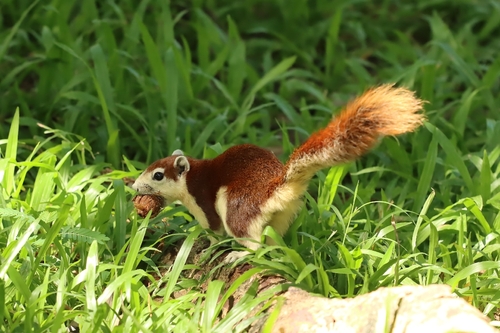
Few mammal species display such an extreme range of colours within the same species. Depending on the population, Finlayson's Squirrel can be intense orange, cream, black, or a striking mix of white and grey. This variety confuses even those who specifically look for it.
Native to Southeast Asia, it now also lives ferally in cities in Italy and Japan. There, its conspicuous colouring is often the first clue that something does not fit with the local fauna. It is, in a way, a squirrel that wears its own camouflage in reverse.
Medium-sized arboreal squirrel with extreme colour variability between populations, ranging from almost uniform orange or cream to black, and including white and grey combinations. Long, bushy tail proportional to the body. In areas where it has been introduced, Finlayson's Squirrel is distinguished from native squirrels by its unusual colouring, which is unnatural for local fauna.
Track with 4 fore toes and 5 hind toes, 3-4 cm long. Small, elongated droppings, 0.8-1.2 cm long, scattered beneath frequented trees. Finlayson's Squirrel leaves gnawed fruits and pine cones with radial incisor marks, and builds globular nests of branches in tree crowns; in temperate introduced areas, its presence is often revealed by visible bark stripping on young branches and trunks.
Tropical forests and wooded areas, including urban parks and gardens. Native to Thailand, Myanmar, Cambodia, Laos, and Peninsular Malaysia, and introduced and established in parts of Europe (Italy), Japan, and Singapore.
Omnivorous: fruit, seeds, shoots and bark, and occasionally insects.
Diurnal and arboreal, active year-round without hibernating, Finlayson's Squirrel reproduces several times a year. In introduced populations in temperate climates, it has shown great adaptability to winters colder than those in its native range.
In its native range in Southeast Asia, populations are considered stable and widely distributed. Introduced populations in Europe and Japan are actively expanding and are subject to eradication or control programmes due to their invasive nature.
In its native range, no significant threats have been identified; in introduced areas, Finlayson's Squirrel itself is a threat to native squirrels and to ornamental and fruit trees due to bark stripping.
See all species accounts for rodents · Full species index
Mammaling is a free app for logging the mammals you find. You record a sighting in a moment — even if it's just a track — your life list grows, and the record becomes available to scientific and conservation projects.
It runs on your phone with nothing to install. If you like, it adds to your home screen like any other app.
Open Mammaling