Illustration generated with artificial intelligence from reference sources and reviewed by the team. Use it as a guide, not as a definitive identification key: it may contain errors in anatomical details such as the number of toes, claw marks or the scale. If something looks off, write to us at [email protected]: corrections from people who know the field are what keep improving these plates.
The Western Roe Deer is the smallest and most widespread deer in Europe, so adaptable that it moves with equal ease through dense forest or along the edge of a cultivated field beside a road. It has a reproductive peculiarity little known outside mammalogy: although mating occurs in summer, the embryo arrests its development for several months, not implanting in the uterus until winter. This ensures birth arrives in spring, synchronised with the explosion of tender vegetation, even though mating took place half a year earlier. Males mark their territory by scraping the bark of young trees with their small antlers, leaving scars that betray their presence long after they have left.
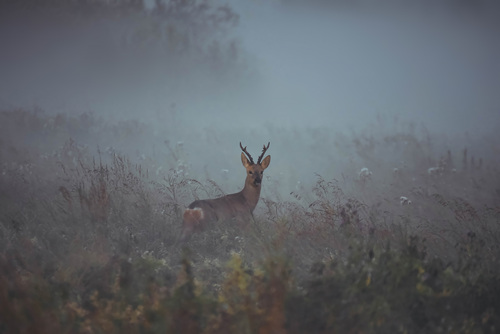
A small deer, with a reddish coat in summer that turns greyish-brown in winter, and a white rump patch very visible when fleeing, more marked in winter. Males bear small, upright antlers with few points, which they lose and renew each year. It differs from the Fallow Deer, which is larger and has palmate antlers in adult males. It also differs from the Red Deer, which is notably larger and lacks such a contrasting rump patch.
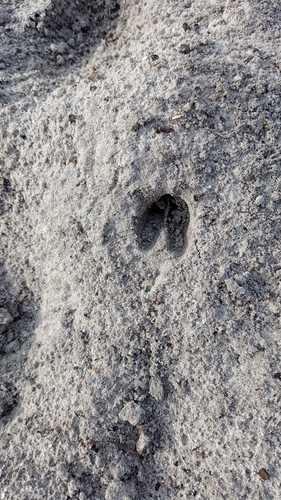
Narrow, pointed track, 3.5-4.5 cm long, with the two hooves very close together and parallel, finer and more elongated than that of a similarly sized domestic sheep or goat. Droppings in the form of elongated pellets, pointed at one end, 1-1.5 cm long, grouped in piles. Males leave rubbing marks and bark stripping on young tree trunks during the summer oestrus period. These leave a characteristic vertical scar visible for years. They also make scrapes on the ground near these marks.
Deciduous and mixed woodland with clearings, scrub, and agricultural areas at woodland edges, from lowlands to mid-mountain areas. Distributed across much of Europe and western Asia, with a notable recent expansion into agricultural and peri-urban landscapes in many regions.
A selective herbivore, it feeds on tender shoots, leaves, grass, and fruit seasonally, preferring high-quality nutritious plant material over coarse grass.
Territorial during spring and summer, when males defend fixed areas against other males. In winter, it can form more tolerant mixed groups. It exhibits delayed implantation: mating occurs in mid-summer, but the embryo does not implant in the uterus until late in the year. Actual foetal development therefore lasts about 5 months, although total gestation exceeds 9 months.
Western Roe Deer populations are numerous and expanding across most of Europe. This is favoured by the abandonment of agricultural land and game management, with no current signs of widespread decline.
Roadkill where roads cross its habitat, local overabundance causing agricultural and forestry damage and conflicts with game management, and competition with other introduced deer species in some areas.
See all species accounts for even-toed ungulates · Full species index
Mammaling is a free app for logging the mammals you find. You record a sighting in a moment — even if it's just a track — your life list grows, and the record becomes available to scientific and conservation projects.
It runs on your phone with nothing to install. If you like, it adds to your home screen like any other app.
Open Mammaling