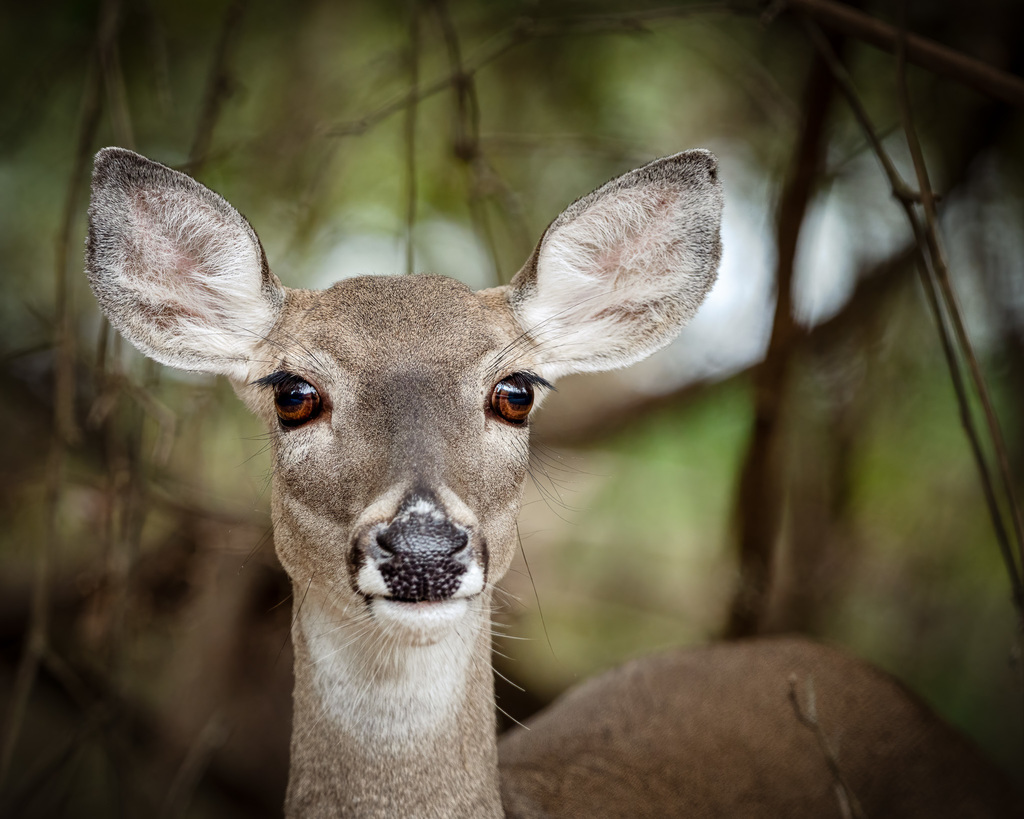
When startled, it raises its tail like a conspicuous white flag and bolts — an alarm signal that alerts other group members and, according to some researchers, briefly confuses pursuing predators. It is the most widely distributed deer in the Americas, occurring from southern Canada down to much of South America. Its body size varies enormously by region: large northern populations in cold climates contrast sharply with tiny tropical and island races further south, which are barely the size of a large dog. Its ability to adapt to human-altered landscapes, combined with the loss of its main predators across much of its range, has led to population densities so high in some areas that it is now treated as a management problem rather than a conservation issue. Males shed and regrow their antlers annually, an osseous tissue that grows at one of the fastest rates recorded in any mammal.
A medium-sized deer with reddish-brown summer pelage turning greyish in winter, and a tail with a pure white underside displayed when fleeing. It differs from the Mule Deer by this longer, fully white-undersided tail, proportionally smaller ears, and the male antlers, which feature a single main beam from which points branch off, rather than the bifurcated branching seen in the Mule Deer.
Tracks and signs: cloven track shaped like an inverted heart, 5-7 cm long, somewhat narrower and more pointed than that of the Mule Deer. Droppings are elongated pellets 1-2 cm long, deposited in piles of several dozen in feeding and resting areas. Fleeing tracks and signs are recognised by an asymmetrical gallop with long strides, markedly different from the four-footed stotting leap of the Mule Deer. Males also leave rubbing posts on young tree trunks with bark torn vertically, as well as scrapes on the ground during the rut, which carry a strong smell of urine.
Extremely varied, from forest and woodland edges to scrub, grassland and agricultural land, ranging from lowlands to mid-altitude mountains. Distributed across much of North America, Central America and northern South America, with body size varying greatly by region.
A browsing herbivore feeding on leaves, shoots, fruit and grass, adjusting its diet to seasonal and regional plant availability.
Lives in groups of related females and their young, whereas adult males are more solitary outside the rut. During the autumn rut, males compete for access to females by pushing with their antlers, which are renewed entirely each year.
Populations are considered stable or increasing across most of its range. In many North American regions, densities are so high they are deemed excessive for forest ecosystem balance, although certain tropical and island populations in the south are far smaller and more localised.
It faces no significant threats as a species. Locally, overpopulation in the absence of natural predators leads to frequent roadkill incidents and damage to forestry and agricultural crops.
See all species accounts for even-toed ungulates · Full species index
Mammaling is a free app for logging the mammals you find. You record a sighting in a moment — even if it's just a track — your life list grows, and the record becomes available to scientific and conservation projects.
It runs on your phone with nothing to install. If you like, it adds to your home screen like any other app.
Open Mammaling