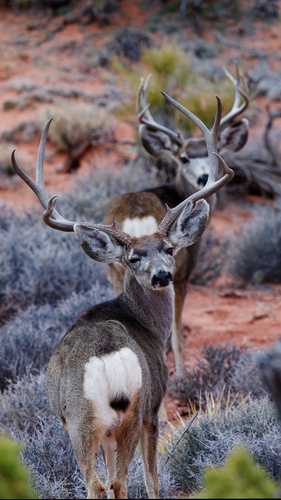
It owes its name to enormous ears, almost as long as those of a mule, which can move independently to locate the origin of a sound before even seeing the possible predator. When it fled it does not run to the galop as most deer, but it jumps with the four legs at the same time in a very characteristic rigid and rebotant movement, a form of displacement that allows it to change direction abruptly on accidental terrain. It lives in a mosaic of very different habitats along the west of North America, from desert reef to mountain forest, and in many populations it performs seasonal migrations between high summer zones and more temperate valleys in winter. It shares a good part of its area with the white tail vein, with which it lives without just hybridizing despite being very close species.
A mid-sized, grey brown fur in winter and redder in summer, very large ears, and white tail with the black tip that falls when fleeing. It differs from the white tail tail by those much larger ears, by the shorter tail and with black tip instead of completely white below, and by its way of jumping away with the four legs at a time instead of the galope; males also have branched tails instead of the single axis with white tail tail tails.
Fractured footprint in the shape of an inverted heart, 6-8 cm, slightly more rounded and wide than that of a similar-size white tail vein. Excrements in the shape of bolitas or, at times of greater moisture in the diet, in agglutinated masses, 1-1.5 cm, left in clusters scattered by food and rest zones. The trace of escape is very diagnostic: marks of the four legs grouped and very close to each other, repeated at regular intervals of several meters, resulting from their characteristic jump with the four legs at a time, very different from the asymmetric galop trace of a white tail vein.
Very varied, from desert grain and prairie to mountain coniferous forest, from low lands to alpine hills in summer. Distributed in the west of North America, from Alaska and the west of Canada to the center of Mexico.
Herbivore, it feeds on leaves, springs and branches of bushes and young trees, with a variable proportion of grass depending on the season and region.
It lives in loose groups of variable composition, more numerous in winter, and many populations carry out seasonal migrations of several tens of kilometers between summer zones in height and winter valleys at lower altitude.
Its populations are generally considered stable on the species scale, although several regional populations have shown declines associated with the loss of traditional migration routes by infrastructure development.
Fragmentation of seasonal migration routes by roads, walls and urban development, and competition and overlap of habitat with white tail veins in some areas.
See all species accounts for even-toed ungulates · Full species index
Mammaling is a free app for logging the mammals you find. You record a sighting in a moment — even if it's just a track — your life list grows, and the record becomes available to scientific and conservation projects.
It runs on your phone with nothing to install. If you like, it adds to your home screen like any other app.
Open Mammaling