
Illustration generated with artificial intelligence from reference sources and reviewed by the team. Use it as a guide, not as a definitive identification key: it may contain errors in anatomical details such as the number of toes, claw marks or the scale. If something looks off, write to us at [email protected]: corrections from people who know the field are what keep improving these plates.
The Common Fallow Deer (Dama dama) is the only European deer with palmate antlers, a feature so characteristic that it allows identification from a distance even without seeing the rest of the animal. Its summer coat, spotted white on a reddish-brown background, resembles that of a fawn, a pattern it retains throughout its life. This contrasts with a range of colour variants, from almost white to almost black individuals, which can coexist in the same population. Although today the Common Fallow Deer is mainly associated with parks and hunting estates across central Europe, its wild origin lies in the eastern Mediterranean, from where humans transported it to much of the continent thousands of years ago.
A medium-sized deer. Its reddish-brown coat is spotted with white in summer, becoming more uniform and greyish in winter. It has a striking black-bordered white rump patch and a long, dark tail, more visible than those of other European deer. Adult males carry palmate, shovel-shaped antlers, unmistakable compared to the stick-like antlers of the Red Deer or the small, unbranched antlers of the Roe Deer.
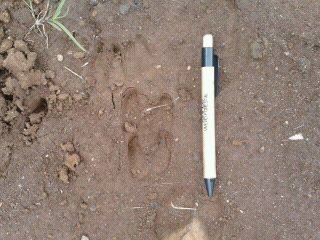
Track similar to Common Red Deer but smaller, 5-7 cm long, with hooves slightly more rounded at the tip. Droppings are elongated pellets, 1.5-2 cm long, grouped in piles under day beds. Males mark territory during the autumn rut with scrapes on the ground and antler rubbing on shrubs and young trees, which leaves torn bark. Their roar is more acute and broken than that of Common Red Deer, making it easy to distinguish by ear in areas where both species overlap.
Open deciduous woodland with clearings and grassland, preferring mosaic landscapes of woodland and pasture, from lowlands to mid-mountain areas. Native to the eastern Mediterranean, it is today widely distributed across much of Europe due to ancient and modern introductions for hunting and ornamental purposes.
Herbivorous, it feeds on grass, leaves, shoots and fruit seasonally, able to exploit both open pasture and woodland edge vegetation.
It forms single-sex groups for most of the year, with males and females meeting only during the rut in autumn, when males compete for access to females in display areas known as leks. It is gregarious, forming herds larger than those of other similarly-sized European deer.
The Common Fallow Deer maintains numerous and stable populations in most regions where it has been introduced, partly due to its popularity in game management and ornamental use. However, its original native population in the eastern Mediterranean is much smaller and more vulnerable.
In some estates and parks, local overabundance causes forest and agricultural damage. It also leads to hybridisation and competition with Common Red Deer populations in areas where Common Fallow Deer has been introduced. Its situation is much more precarious in its original native range than in the rest of its current distribution.
See all species accounts for even-toed ungulates · Full species index
Mammaling is a free app for logging the mammals you find. You record a sighting in a moment — even if it's just a track — your life list grows, and the record becomes available to scientific and conservation projects.
It runs on your phone with nothing to install. If you like, it adds to your home screen like any other app.
Open Mammaling