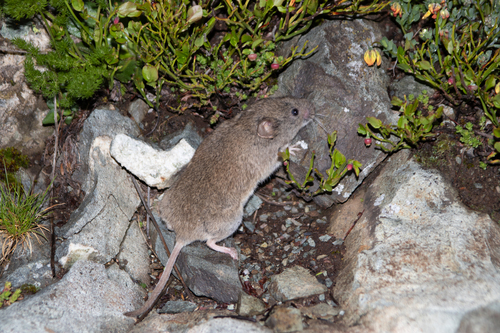
The European Snow Vole lives in one of the most hostile environments any European rodent can occupy: high-mountain scree and rocky areas above the treeline. Here, it remains active under the snow for much of the winter, thanks to a network of tunnels excavated among rock crevices. Its populations are distributed in high-mountain fragments, separated by valleys and lowlands that it never crosses. This archipelago distribution pattern is repeated in several mountain ranges in Europe and Western Asia, turning each mountain massif into a natural laboratory of isolated evolution. It can tolerate extreme temperatures thanks to a cold-adapted metabolism and dense fur. It shares these qualities with very few other rodents on the continent.
Medium-sized rodent, fur greyish-brown to lead-grey on the back and greyish-white on the belly, compact body and very long whiskers in proportion to its head. It differs from other European Voles by its strictly rocky, high-mountain habitat and by its paler greyish fur, distinct from the reddish-brown tone of most Lowland Voles.
Small tracks, 1.5-2 cm long, rarely visible except in fine snow near rock crevices it uses as shelter. Droppings are small and rounded, 3-5 mm long, deposited in small piles inside the rock crevices where it lives, often alongside vegetation remains dragged into the shelter. It is mainly detected by the crevices and hollows between stone blocks it uses as a burrow system. Cut grass and stem remains accumulate at the entrance as a food store for winter, a behaviour uncommon among voles of lower altitudes.
Scree, rocky areas and high-mountain cushion scrub, generally above the treeline, between 1500 and over 4000 m depending on the region.
Its distribution is highly fragmented across the main mountain ranges of southern Europe, North Africa, and Southwest Asia. Populations are isolated from each other by intervening lowlands that the European Snow Vole never occupies.
Herbivorous, it feeds on high-mountain grass, moss, and lichen. It accumulates reserves of dry vegetation in its rocky refuge to survive months of continuous snow.
Active year-round, even under snow, thanks to the network of tunnels it maintains among rock crevices. It does not enter true hibernation despite the extreme cold of its habitat. It lives in small family colonies, with a territory closely linked to the availability of suitable rocky refuge.
Its populations are generally stable throughout most of its high-mountain range. However, its strong specialisation in a very specific and fragmented habitat makes it potentially vulnerable in the medium term to the altitudinal shift of vegetation associated with climate change.
Available high-mountain habitat for the European Snow Vole is being reduced. This is caused by the altitudinal ascent of forest vegetation associated with climate change. The ascent progressively shrinks the area of scree and alpine grassland it occupies. This also results in increasing genetic isolation between populations in different mountain ranges.
See all species accounts for rodents · Full species index
Mammaling is a free app for logging the mammals you find. You record a sighting in a moment — even if it's just a track — your life list grows, and the record becomes available to scientific and conservation projects.
It runs on your phone with nothing to install. If you like, it adds to your home screen like any other app.
Open Mammaling