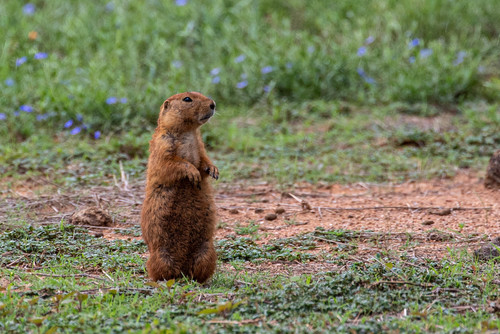
The Black-tailed Prairie Dog lives in colonies so extensive and densely populated that early European explorers of the North American Great Plains described some as veritable underground cities. These contained tens of millions of individuals spread over hundreds of kilometres, probably the largest concentrations of colonial mammals ever documented on the continent. It is the most widespread of the five North American prairie dog species. Its alarm call system is so elaborate that studies suggest it can describe, using distinct sounds, the size, shape, and even colour of an approaching predator. Its role as an ecosystem engineer is enormous: its burrows aerate the prairie soil and provide shelter for dozens of other species, from Burrowing Owls to snakes, which depend on its abandoned tunnels. Despite this key ecological role, it has been persecuted for over a century as
A medium-sized rodent with a robust body and yellowish-brown fur. Its rounded head has small ears almost hidden in the fur. The black tip of its tail gives the Black-tailed Prairie Dog its name. It differs from other ground squirrels in the region by its larger size, its strictly colonial life in very visible burrows, and its characteristic black-tipped tail, which distinguishes it from the white tail of other prairie dog species.
Track with 4 fore toes and 5 hind toes; hind track 3-4 cm long. Similar to that of other large ground squirrels but almost always associated with the obvious burrow entrances of the Black-tailed Prairie Dog colony.
Small, elongated droppings, 1-1.5 cm long, left scattered throughout the colony.
The most unmistakable sign is the Black-tailed Prairie Dog colony itself: circular mounds of compacted earth up to 1 m in diameter around each burrow entrance. These serve as a lookout post and a barrier against floods, spread throughout the occupied grassland,
Short and medium-grass prairie of the Great Plains, from lowlands to upland areas. Distributed across central North America, from southern Canada to northern Mexico, in the United States and northern Mexico.
Herbivorous, it feeds on grass and low-growing plants, which it also actively keeps trimmed around the colony to improve visibility of predators.
The Black-tailed Prairie Dog lives in very dense, organised colonies. These are structured into family groups called coteries. They have a highly elaborate alarm call system that distinguishes the type and even the characteristics of an approaching predator.
It is diurnal and spends much of the day on the surface, alert, alternating with periods of feeding and burrow maintenance.
Its populations have partially recovered in some areas thanks to specific conservation programmes. However, the total area occupied remains a very small fraction of its historical range. The species is considered globally stable despite local declines due to agricultural pest control.
Poisoning and control as an agricultural pest in some areas, conversion of native grassland to cropland, and periodic outbreaks of sylvatic plague, an introduced disease that can eliminate entire colonies in a few weeks.
See all species accounts for rodents · Full species index
Mammaling is a free app for logging the mammals you find. You record a sighting in a moment — even if it's just a track — your life list grows, and the record becomes available to scientific and conservation projects.
It runs on your phone with nothing to install. If you like, it adds to your home screen like any other app.
Open Mammaling