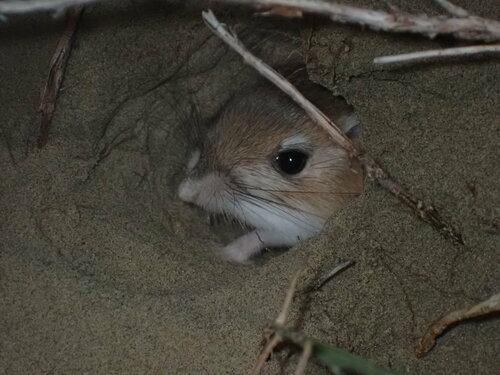
It is one of the most widely distributed kangaroo rats in all of North America, present in a wide variety of arid and semi-arid habitats from Canada to the center of Mexico, which makes it one of the best-studied desert rodent species on the continent. Like the rest of kangaroo rats, it moves to large jumps driving only with its rear legs, much longer than the front legs, and never needs to drink liquid water, getting all that it needs from the metabolism of the dry seeds that constitute most of its diet. Excavate kangaroo rats relatively simple compared to the other kangaroo rats of greater size, often under the basis of a bush that offers shade and stability to the ground.
Small-sized rodent, yellow brown fur in the back and white in the belly, lengthy back legs adapted to jump displacement, and long tail with a terminal mouthpiece. It differs from other canguro rats of greater size in the region, such as the tail canguro rat with a flag, by its smaller size and by building simpler rodents without the characteristic large mount of those species.
Footprint with lengthy rear legs leaving paired jump marks, 2-2.5 cm each, separated by unmarked branches where the animal is pushed into the air. Small, lengthy excrete, 5-7 mm, left dispersed near the spruce. Excavate relatively simple spruce marks in loose soil, often under the base of a bush, with the semi-cultured entrance and without the large land mount characteristic of other larger kangaroo rats.
Desert and turf dry and semi-arid on sandy or loose soil, from low lands to transition zones to the mountain desert. Distributed by much of the west of North America, from southern Canada to the center of Mexico.
Granivorous, it feeds mainly on seeds, complemented with green grass and occasional insect, transported in external bags covered with hair to the nursery.
Solitary and territorial, it defends its caterpillar against other individuals of the species.It is strictly nocturnal activity, with jumping displacement that allows it to quickly escape nighttime predators from the desert.
Its populations are considered stable in the vast majority of its wide area of distribution, without signs of significant decline at species level.
It does not face significant threats at species level; locally suffers habitat loss due to agricultural and urban conversion in some areas of its distribution area.
See all species accounts for rodents · Full species index
Mammaling is a free app for logging the mammals you find. You record a sighting in a moment — even if it's just a track — your life list grows, and the record becomes available to scientific and conservation projects.
It runs on your phone with nothing to install. If you like, it adds to your home screen like any other app.
Open Mammaling