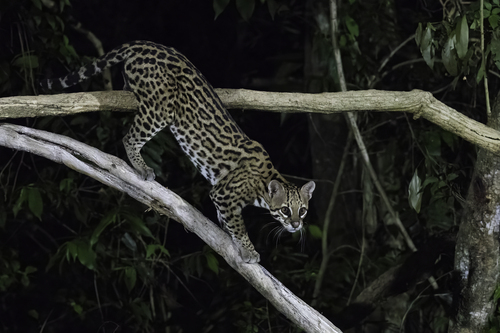
It is one of the most widespread spotted felines in America, able to live both in dense jungle as in dry roof or gallery forest, as long as there is sufficient vegetable coverage to hunt at night. It hunting mainly at night small soil prey, from rodents to reptiles, and its striking motifed fur was for decades the object of an intense hunt for leather trade that decimated much of its populations. Although on a global scale its situation is favorable, at the northern end of its distribution, in the south of the United States and northern Mexico, it survives in populations so small and fragmented that they are classified as in danger.
A medium-sized cat, somewhat larger than a large domestic cat, with wool covered with lengthy spots and open rosettes bordered with black arranged in oblique lines. It differs from the margay, very similar in coat pattern, by its larger size, shorter tail in proportion to the body and proportionally smaller eyes; from the jaguarundi is easily distinguished by the motifed coat against the smooth and uniform coat of the latter.
Round footprint without nail marks, 4-5 cm, slightly larger than that of a domestic cat and with the typical straight-line pattern of felines, in which the rear legs scratch on the mark left by the fronts. Cylindrical and segmented feces, 6-8 cm, with hair and visible bone, often deposited without burial on elevated points or crosses of paths as a territorial mark. Leave garlic marks on sloping trunks used to sharpen the nails, and sprayed urine with an intense stinking smell at repeated passing points.
Tropical rainforest, gallery forest, thorns and mangroves, from low lands to mid-mountain heights. Distributed from the south of the United States to the north of Argentina, with the northernmost populations very fragmented.
Carnivorous, hunting mainly small mammals, birds, reptiles and soil amphibians, located at the bottom thanks to a highly developed ear and smell.
Solitary and territorial, of mainly nightlife activity, with males occupying far larger fields than the females and usually overlaping with several females. reproduction is not linked to a fixed time in most of its tropical area, and breeding remains with the mother several months after discharge.
On a global scale, its populations are considered stable thanks to their wide distribution and their ability to adapt to different types of habitat, although at the northern end of their area, in the south of the United States and northern Mexico, only a handful of individuals survive in isolated populations subject to reintroduction programs and connectivity courses.
Habitat fragmentation due to agricultural expansion and infrastructure, road crashes in northern populations, and punctual furtive hunting despite the widespread ban on the trade in their skin.
See all species accounts for carnivores · Full species index
Mammaling is a free app for logging the mammals you find. You record a sighting in a moment — even if it's just a track — your life list grows, and the record becomes available to scientific and conservation projects.
It runs on your phone with nothing to install. If you like, it adds to your home screen like any other app.
Open Mammaling