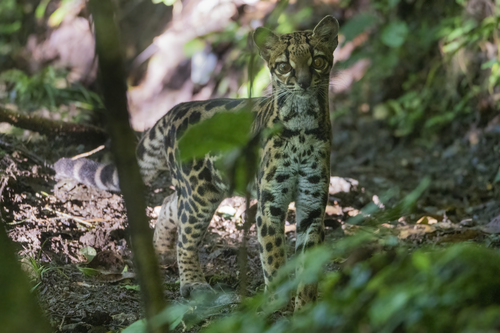
The Margay is probably the most acrobatic feline in the Americas, with ankles capable of rotating 180 degrees. This allows it to descend trees headfirst like a squirrel, a feat no other wild cat in the world can achieve with such agility. It spends much of its life in the tree canopy, hunting arboreal prey such as birds and small primates. In the jungle, it shares habitat with much better-known felines like the Ocelot or the Jaguar. Its strong resemblance to the Ocelot, from which it is mainly distinguished by size and body proportions, has long made it difficult to accurately assess the true status of its wild populations.
A small cat, similar in size to a large domestic cat but with proportionally much longer limbs and tail, and yellowish-brown fur with elongated dark spots and rosettes. Easily confused with the Ocelot, which is notably larger and has more compact proportions. The Margay, by contrast, has disproportionately large eyes and a very long tail (more than half its body length). Its hind ankles are capable of rotating for head-first descent down tree trunks.
A rounded track, 3-4 cm across, with 4 toes and no claw marks as they are retractable. It is similar to the Ocelot's but notably smaller.
Cylindrical droppings with segments, 5-8 cm long, containing hair and small bone fragments. They are often deposited on fallen logs or elevated rocks as a territorial mark, a behaviour more frequent than in the Ocelot.
The Margay marks trees with vertical scratches and facial rubbing on trunks used as habitual crossing points. It can also be detected by remains of arboreal prey, such as predated bird nests found at height, which is unusual for other felines of its size.
Dense humid and semi-deciduous tropical forest, strongly dependent on continuous tree cover, from lowlands up to 3,000 m in some Andean areas. Distributed throughout much of Central and South America, from northern Mexico to northern Argentina, its presence closely linked to well-preserved forest.
A carnivore, it primarily hunts arboreal prey: birds, small primates, rodents, and reptiles, captured with an agility and climbing ability unusual among felines.
Solitary and territorial, the Margay is mainly nocturnal, with a large home range relative to its body size. It is one of the most arboreal felines in the world, capable of spending most of its life barely descending to the ground in dense forest areas.
Its populations are considered to be in continuous decline across much of its range, mainly due to the loss of dense forest, on which it is almost entirely dependent. The situation is better documented and less critical than that of other small American felids, although general trends indicate sustained deterioration.
Loss and fragmentation of tropical forest due to agricultural and livestock expansion, historical hunting for its fur (much less relevant today), and roadkill in areas where roads cross the forest.
See all species accounts for carnivores · Full species index
Mammaling is a free app for logging the mammals you find. You record a sighting in a moment — even if it's just a track — your life list grows, and the record becomes available to scientific and conservation projects.
It runs on your phone with nothing to install. If you like, it adds to your home screen like any other app.
Open Mammaling