Illustration generated with artificial intelligence from reference sources and reviewed by the team. Use it as a guide, not as a definitive identification key: it may contain errors in anatomical details such as the number of toes, claw marks or the scale. If something looks off, write to us at [email protected]: corrections from people who know the field are what keep improving these plates.
Just twenty years ago, the Iberian Lynx was, by far, the most endangered feline on the planet. Its wild population numbered around a hundred individuals, distributed in two isolated nuclei in the south of the Iberian Peninsula.
Today, it is one of the most cited large carnivore recovery cases worldwide. Its population has multiplied by more than thirty in two decades, thanks to captive breeding, reintroduction, and the recovery of its main prey, the Rabbit.
It is the only lynx that lives exclusively in the Iberian Peninsula. Its recent history demonstrates that even recovery from a nearly irreversible situation is possible with sufficient sustained effort.
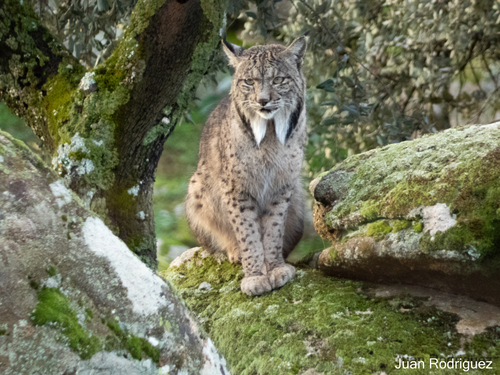
Medium-sized felid, smaller and with proportionally longer legs than the Boreal Lynx. It has a tawny coat with well-defined dark spots, black hair tufts on the ear tips, and a striking 'beard' of hair around the face. It differs from the Boreal Lynx, with which it does not overlap geographically, by its smaller size and much more distinct spot pattern.
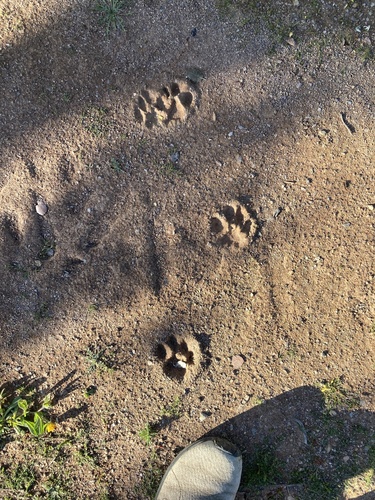
Rounded track, 5-6 cm, with four toes and no claw marks, as the Iberian Lynx retracts its claws when walking, like other felines. This contrasts with similarly sized canids, which always show claw marks. Droppings are cylindrical and segmented, 6-10 cm long, often covered with earth or left uncovered on elevated spots as a territorial mark. Rabbit hair remains are almost always present. The Iberian Lynx leaves scratch marks on tree trunks and scrapes on the ground near its territory boundaries. Its presence is also often revealed by partially consumed rabbit remains, which show a characteristic bite pattern on the neck.
Dense Mediterranean scrub, low scrubland, and Holm oak and cork oak forest with good availability of Rabbits, in low and medium altitude areas. Distributed exclusively in the south and centre of the Iberian Peninsula, in population strongholds connected by reintroduction projects in recent years.
The Iberian Lynx is a specialist predator of the European Rabbit, which can make up almost its entire diet in years of abundance. This is supplemented with birds, rodents and occasionally young of ungulates when European Rabbits are scarce.
Solitary and territorial, with territories that may partially overlap between one male and several females. Reproduction is closely linked to rabbit availability, with births concentrated in spring. Litters comprise 2-4 young, which remain with the mother well into their first year of life.
The population has grown from just 62 mature individuals in 2001 to over 2000 total individuals today. Its home range has multiplied several times thanks to captive breeding, reintroduction into new areas, and the recovery of Rabbit populations. However, its distribution remains concentrated in a limited number of interconnected nuclei.
New outbreaks of rabbit viral diseases that reduce its main prey, roadkill on busy roads that cross its habitat, occasional poaching, and alteration of Mediterranean habitat associated with climate change.
See all species accounts for carnivores · Full species index
Mammaling is a free app for logging the mammals you find. You record a sighting in a moment — even if it's just a track — your life list grows, and the record becomes available to scientific and conservation projects.
It runs on your phone with nothing to install. If you like, it adds to your home screen like any other app.
Open Mammaling