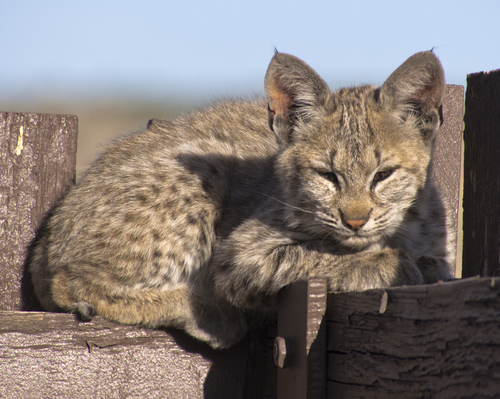
It is the most common and widespread wild cat in North America, able to live from deserts to snowed forests and rocky mountain areas, thanks to a very flexible diet and a remarkable tolerance to human presence on the edges of its habitat. Its name alludes to the short and truncated tail, very different from the long tail of most felines, a trait that it shares with its northernmost relative, the Canadian lynx, with which it is often confused in the areas where they coincide. It hunting mainly to axe, taking advantage of the vegetable coverage to approach without being detected before launching a short and explosive attack. Its population has remained notably stable in much of its distribution area despite centuries of hunting for leather trade.
Medium-sized, red to gray brown fur with variable dark spots and strips, ears with small short spots and short tail with the black tip only on the upper face. It differs from the Canadian lynx, with which it overlaps in the north of its area, by its much smaller ears and ears, its more marked spots and by the bottom of the white tail tip rather than completely black.
Round footprint without nail marks, 4-5 cm, with the typical straight-line pattern of the felines, slightly smaller and more compact than that of the Canadian lynx and without the large coated size that allows the latter to walk on soft snow. Cylindrical and segmented feces, 6-9 cm, with hair and visible bone, often partially buried in small scratching pitches or deposited without buriing in elevated points as a territorial mark. Leave tail marks on trunks used as sharp points, and prey partially buried under leaf when you do not consume the entire capture at once.
Very varied, from desert and meadows to temperate forest and rocky mountain areas, from low lands to high heights.
Carnivorous, hunting mainly rabbit and liebre, complemented with rodent, bird and, occasionally, larger-sized prey as a young serpent in winter.
Solitary and territorial outside the breeding season, of activity mainly crepuscular and nocturnal although it can hunt day in areas with little human pressure.The males occupy far larger fields than the females, and often overlap with the females of several neighboring females.
Its populations are considered stable or increasing in most of its wide distribution area, favored by the recovery of the populations of its main prey and by a regulated cinegetic management in most states and provinces where it is still hunted.
Road crashes, hunting and trampoline regulated for leather trade in part of its area, and punctual loss of habitat due to urban expansion.
See all species accounts for carnivores · Full species index
Mammaling is a free app for logging the mammals you find. You record a sighting in a moment — even if it's just a track — your life list grows, and the record becomes available to scientific and conservation projects.
It runs on your phone with nothing to install. If you like, it adds to your home screen like any other app.
Open Mammaling