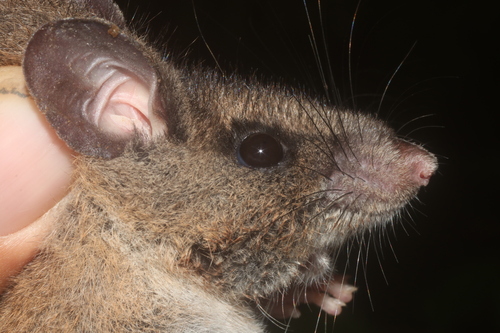
One of the largest rodents among the endemic murids of the mountains of Veracruz, Nelson's Big-toothed Deermouse has disproportionately large teeth that give their name to its entire genus, allowing it to process tougher food than most of its mountain forest relatives. It lives in the cloud forest and pine-oak forest of the mountains near Xalapa, central Veracruz, an area considerably transformed by the expansion of coffee plantations and urban areas in recent decades. Its name honours the American naturalist who also gives his name to several other Mexican small mammal species documented in the early 20th century. It is a good example of how Mexico's mountainous geography, with its isolated ranges, has generated species with very restricted distributions from relatively widespread rodent lineages.
A large rodent for a Mesoamerican murid, with greyish-brown fur, large ears, and teeth remarkably developed in proportion to the skull. Nelson's Big-toothed Deermouse differs from other mountain forest rodents in Veracruz by its larger size and particularly large teeth, a characteristic feature of its entire genus.
Track with 4 front toes and 5 hind toes, the hind track 2-2.5 cm long. Elongated droppings 8-10 mm long, left scattered along surface runways under dense understorey vegetation. It builds grass and moss nests in hollows beneath fallen trunks or roots in the damp soil of the cloud and pine-oak forest where it lives.
Cloud forest and mountain pine-oak forest with a dense understorey, generally between 1,500 and 2,500 m altitude. Endemic to the mountains near Xalapa, central Veracruz state, eastern Mexico.
Omnivorous, feeding on seeds, fruit, fungi and invertebrates from the mountain forest floor.
Terrestrial habits, with solitary and territorial behaviour. It is probably nocturnal, like the other rodents in its genus.
Its populations are considered to be in decline due to the ongoing loss of the cloud and pine-oak forest on which it depends, increasingly converted into coffee plantations and urban areas in the mountains near Xalapa.
Deforestation and the conversion of mountain forest into coffee plantations and urban areas, alongside the species' geographical restriction to a relatively small area near Xalapa.
See all species accounts for rodents · Full species index
Mammaling is a free app for logging the mammals you find. You record a sighting in a moment — even if it's just a track — your life list grows, and the record becomes available to scientific and conservation projects.
It runs on your phone with nothing to install. If you like, it adds to your home screen like any other app.
Open Mammaling