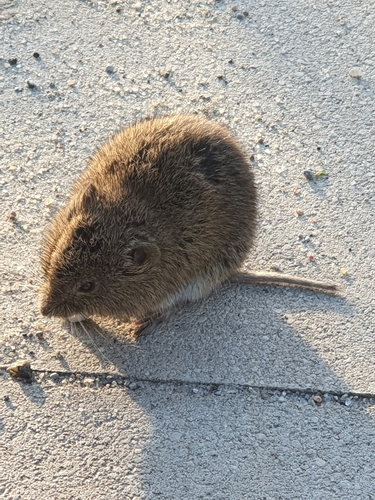
Few mammals illustrate the concept of "population explosion" as well as the Common Vole: its populations can multiply tenfold or more in a few months when conditions are favourable, leading to periodic agricultural outbreaks that recur regularly every few years. It forms the dietary base for a large proportion of European predators, from raptors to foxes and weasels, whose own reproductive success often depends directly on these cycles of abundance. It lives underground most of the time, in a system of tunnels that is rarely seen but can visibly transform the appearance of a meadow in years of high density.
Small rodent, greyish-brown fur, short tail (less than half the body length) and small ears almost hidden in the fur.
It is confused with other voles and with the wood mouse, from which it differs by its much shorter tail and less prominent ears, typical of a rodent better adapted to subterranean life.
Tiny track, 1-1.5 cm, with 4 front and 5 hind toes, rarely visible except in snow or very fine mud. Small, elongated droppings, 4-6 mm long, found in large quantities scattered along tunnels and surface runways connecting burrows. The clearest sign of its presence is networks of shallow tunnels and mounds of excavated earth in meadows and cultivated fields, along with surface runways visible in the grass when population density is high.
Meadow, grassland, herbaceous crops, and field edges, preferring soft soils that facilitate excavation, from lowlands to mid-mountain areas. Distributed across much of continental Europe and Western Asia.
Herbivore: grass, roots and tender stems, and in agricultural crops, also seeds and vegetables, making it a pest in years of high density.
The Common Vole lives in underground colonies with a certain social structure; females may share space with young from successive litters. Its populations show very marked abundance cycles, several years long. These cycles alternate between phases of high density and abrupt collapses, which are linked to food availability and predator pressure.
The Common Vole maintains extremely numerous and stable populations throughout most of its home range. There is no indication of species-level decline, beyond the cyclical fluctuations inherent to its biology.
The Common Vole faces no relevant threats as a species. On the contrary, it is the target of rodenticide control campaigns during years of agricultural pest outbreaks. This practice can indirectly affect its predators.
See all species accounts for rodents · Full species index
Mammaling is a free app for logging the mammals you find. You record a sighting in a moment — even if it's just a track — your life list grows, and the record becomes available to scientific and conservation projects.
It runs on your phone with nothing to install. If you like, it adds to your home screen like any other app.
Open Mammaling