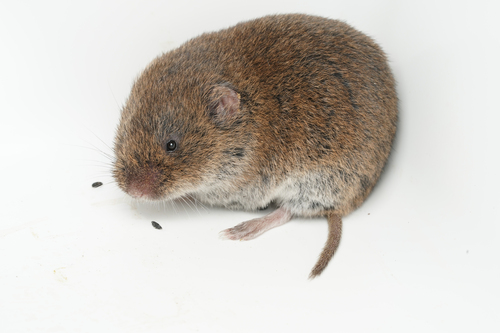
The Pyrenean Pine Vole is a mountain vole with discreet habits. Despite its name directly evoking the Pyrenees, the mountain range where it was first described, it is more associated with damp, stony soils in temperate zones than with high peaks. It lives in populations distributed across much of western Europe. Its digging habits are intermediate between strictly subterranean voles and surface voles, as it moves through both shallow burrows and surface runways through vegetation. Its biology is difficult to study in the field precisely because it closely resembles, both in appearance and behaviour, other vole species with which it shares habitat across much of its range.
Small rodent, greyish-brown to dark brown fur, compact body, small but visible eyes and ears, and short tail.
The Pyrenean Pine Vole can be confused with other voles of similar habits that share its home range. This is especially true for related species that are almost identical in appearance. Reliable species identification often requires examination of dental details or genetic analysis.
Small track, 1.5-2 cm, with four fore toes and five hind toes. Droppings small and rounded, 3-4 mm long, deposited next to shallow burrows and surface runways among vegetation in damp areas. It constructs burrow systems intermediate between those of subterranean voles and surface voles. Entrances are visible as small holes among the grass, with mounds of excavated earth that are more discreet than those of strictly fossorial species.
Damp meadow, mountain scrub and areas of stony ground with herbaceous vegetation, from lowlands to mid and high mountain areas. Distributed across western Europe, with a presence in the Pyrenees, the north of the Iberian Peninsula and areas of the French Massif Central.
Herbivorous, it feeds on grass, surface roots and tender stems from the mountain meadow and scrubland vegetation it inhabits.
The Pyrenean Pine Vole lives in colonies, using a combined system of burrows and surface runways. It is active throughout the day and night. Its reproductive and social biology is similar to that of other voles in the region, producing several litters a year in favourable conditions.
It maintains generally stable populations in most of its mountain range, with no documented signs of widespread decline.
Transformation of mountain meadows for intensive agricultural or livestock use, and, more locally, habitat fragmentation in mid-mountain urban expansion areas.
See all species accounts for rodents · Full species index
Mammaling is a free app for logging the mammals you find. You record a sighting in a moment — even if it's just a track — your life list grows, and the record becomes available to scientific and conservation projects.
It runs on your phone with nothing to install. If you like, it adds to your home screen like any other app.
Open Mammaling