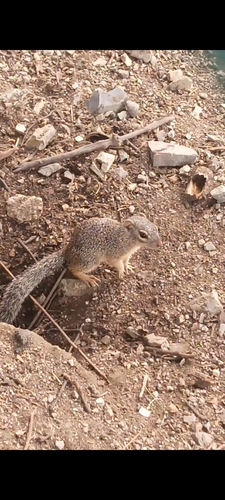
The Tropical Ground Squirrel lives in the lowlands of the Mexican Pacific, between Sinaloa, Michoacán, Guerrero and Oaxaca. It is commonly seen standing on its hind feet at the entrance to its burrow, surveying the area before foraging. Unlike ground squirrels in temperate zones, it does not hibernate. Its activity is instead adjusted to the wet and dry cycle of the tropical deciduous forest it inhabits. Locally, it is known as 'cuinique', and in some agricultural areas, it is considered a minor maize pest.
Cinnamon-brown fur mixed with black hairs, darker on the head, back, and tail. Flanks and inner legs are yellowish, with faint pale stripes above and below the eye. The Tropical Ground Squirrel differs from Tree Squirrels in the same region by its terrestrial habits and more compact body. It also differs from other Ground Squirrels in Mexico by its geographical range, which is restricted to the Pacific lowlands.
Burrows, 6-8 cm in diameter at the entrance, usually open at the base of rocks, roots, or fallen logs, often with several interconnected entrances. Tracks show four toes on the forefoot and five on the hindfoot, with fine, straight claw marks, smaller and narrower than those of any canid in the area. Droppings are small, oval pellets about 6-8 mm long, dark, which accumulate near the burrow entrances and on the paths connecting feeding sites.
Deciduous tropical forest, arid scrubland and crop edges in the lowlands on Mexico's Pacific slope, from Sinaloa to Oaxaca.
Seeds, fruits, green leaves and occasional insects; in agricultural areas it may also feed on maize and other crops.
Diurnal and terrestrial, it lives in burrows, which it may share with other individuals, forming loose groups rather than strict colonies. Its activity reduces during the driest season of the year, though it does not hibernate like ground squirrels in cold climates.
The Tropical Ground Squirrel is considered common and has a stable population in much of its range on the Mexican Pacific slope, although the lack of detailed field studies on its basic ecology makes more precise monitoring difficult.
It is locally hunted as an agricultural pest of maize, and it suffers habitat loss due to the expansion of crops and livestock farming in some areas of its range.
See all species accounts for rodents · Full species index
Mammaling is a free app for logging the mammals you find. You record a sighting in a moment — even if it's just a track — your life list grows, and the record becomes available to scientific and conservation projects.
It runs on your phone with nothing to install. If you like, it adds to your home screen like any other app.
Open Mammaling