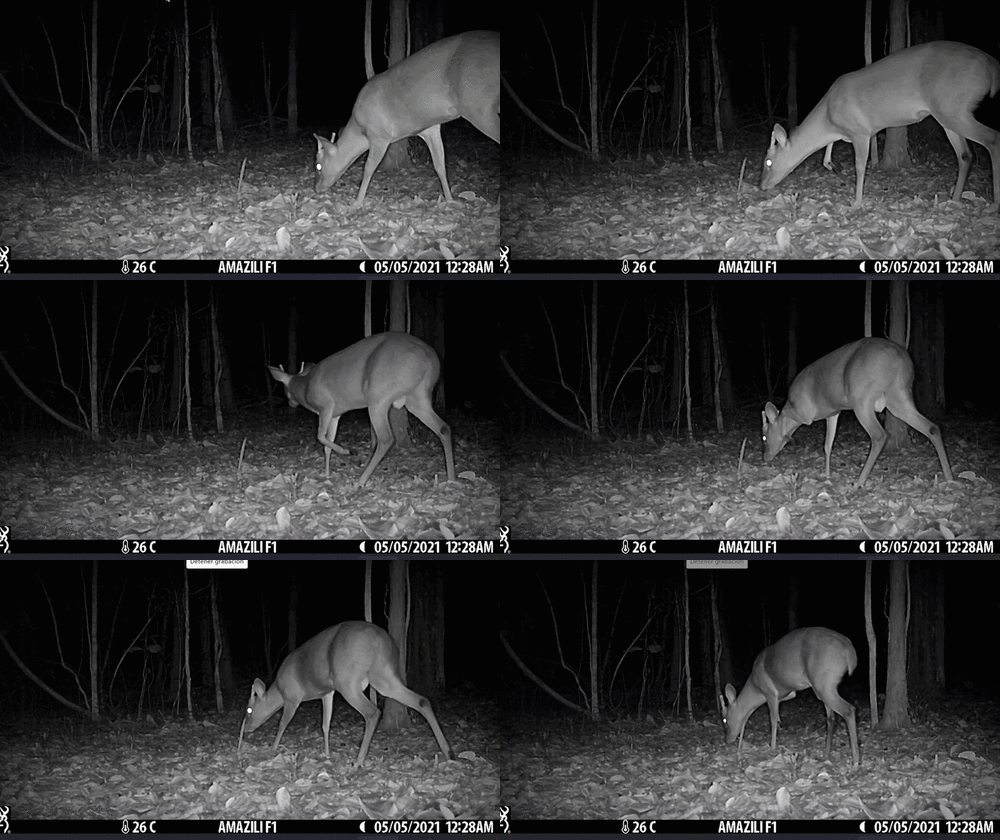
The smallest deer in Mexico, the Yucatan Brown Brocket is a discreet jungle dweller of the Yucatán Peninsula that is rarely seen, preferring to move stooped through dense understorey vegetation rather than venturing into open areas as larger deer do. Unlike the White-tailed Deer, with which it shares part of its range, it does not form groups or develop branched antlers: males carry only two short, simple spikes without additional tines. It lives exclusively in the Yucatán Peninsula, in humid and dry tropical forest, an area that has undergone considerable transformation due to agricultural and livestock expansion in recent decades. Its scientific name has been the subject of taxonomic debate among specialists, who argue whether it should be included in the same genus as the White-tailed Deer or retained in a separate genus alongside other Central American brocket deer.
A small deer, noticeably smaller than the White-tailed Deer, with a uniform reddish-brown coat, a compact body and relatively short legs. Males carry short, simple spikes without branches, very distinct from the branched antlers of the White-tailed Deer; it is also distinguished by its much smaller size and by always moving stooped through dense vegetation rather than in open areas.
Tracks and signs: cloven track with two pointed hooves, 3-4 cm long, noticeably smaller and narrower than that of the White-tailed Deer, with which it shares habitat in part of its range. Droppings in the form of small oval pellets, 1-1.3 cm long, left in small scattered heaps along understorey paths. It leaves low, narrow trails through dense vegetation, very different from the wider paths of the White-tailed Deer, and antler rubbing posts on slender stems during the rut.
Lowland humid and dry tropical forest with dense understorey. Endemic to the Yucatán Peninsula in south-eastern Mexico, Belize and northern Guatemala.
Herbivorous, feeding on leaves, tender shoots, fallen fruit and fungi from the jungle understorey where it lives.
Solitary or in pairs, with discreet and elusive habits, moving stooped through dense vegetation and avoiding open areas. It is mainly nocturnal and crepuscular, and does not form large groups like other deer species.
Its populations are considered to be in continuous decline due to subsistence hunting and forest loss in the Yucatán Peninsula, with an estimated reduction exceeding 30% over the last three generations.
Unregulated subsistence and sport hunting, alongside deforestation and forest fragmentation driven by agricultural and livestock expansion in the Yucatán Peninsula.
See all species accounts for even-toed ungulates · Full species index
Mammaling is a free app for logging the mammals you find. You record a sighting in a moment — even if it's just a track — your life list grows, and the record becomes available to scientific and conservation projects.
It runs on your phone with nothing to install. If you like, it adds to your home screen like any other app.
Open Mammaling