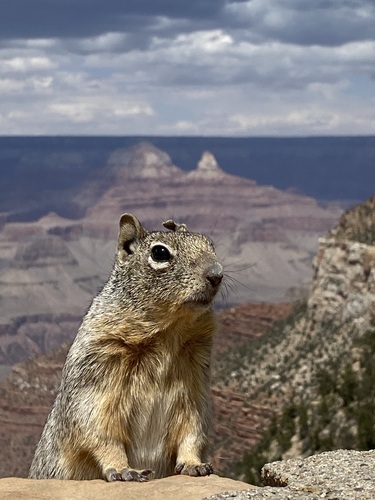
The Common Rock Squirrel is the largest of North American ground squirrels. Although it lives mainly among crags and rocky areas, it climbs trees with surprising agility for a terrestrial animal. It ascends junipers and mesquites to reach berries and flowers, and even scales the tall flower stalks of agaves to eat the flowers. It lives in arid and mountainous areas of southwestern North America and much of Mexico, always associated with rocky outcrops.
The Common Rock Squirrel measures up to 50 cm total length, including a long, bushy tail. Its fur is mottled brown and grey, darker on the back. It is one of the largest ground squirrels in the region. It differs from the California Ground Squirrel (Otospermophilus beecheyi), with which it shares part of its range, by its distinctly larger size and by living among rocks and crags rather than in open grasslands.
It lives in burrows dug under rocks, in rock crevices, or under tree roots, with entrances about 10-12 cm in diameter often semi-hidden among stones. Its tracks, with five toes on the hind feet, differ from those of a dog by their smaller size, 4-5 cm long, and by the fine claw marks compared to the rounded, blunt pads of a canid. It also leaves remains of bark-stripped pine cones, gnawed mesquite seeds, and fruit husks accumulated near its burrow entrances, a sign of its food caches.
It lives in rocky areas, canyons, and arid and semi-arid slopes of the southwestern United States and much of Mexico, from sea level to mid-mountain areas.
It feeds on pine nuts, acorns, mesquite seeds, cactus and agave, cultivated and wild fruits, and insects such as grasshoppers and caterpillars.
It is diurnal and a good climber, despite its terrestrial habits. Common Rock Squirrels store food in their burrows for periods of scarcity. Females raise one or two litters per year.
Listed as Least Concern by the IUCN, with stable populations across most of its wide range in North America.
Loss of rocky habitat from urban expansion and roads in parts of the southwestern United States, and control as an agricultural pest in some farming regions, are the most frequently cited pressures.
See all species accounts for rodents · Full species index
Mammaling is a free app for logging the mammals you find. You record a sighting in a moment — even if it's just a track — your life list grows, and the record becomes available to scientific and conservation projects.
It runs on your phone with nothing to install. If you like, it adds to your home screen like any other app.
Open Mammaling