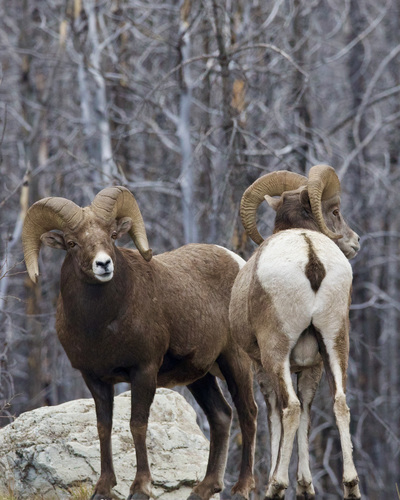
The males fight some of the most spectacular battles in the animal world, loading against each other at more than 30 km/h and shocking their enormous curved horns with an audible impact at hundreds of meters, again and again over several hours until one of the two gives up. They live in sharp southern terrain of mountain and canyon, where their extraordinary ability to climb almost vertical walls allows them to escape most predators refuge in cuts that these cannot follow. Many populations make seasonal migrations between summer areas in height and wintering areas at lower altitude, following traditional routes that are transmitted from generation to generation within each population. There are varieties adapted to very different environments within their area, from the high mountain populations of the Rocks to the desert breeds of North America, much more small and finer counts.
Robust beetle, gray brown fur with whitened rabbit and belly, and massive and spirally curved horns in the male, much thinner and curved in the females. It differs from the mountainous goat introduced in part of its area by its curved horns backwards instead of upwards, and by its hairless beard characteristic of the goat.
Narrow and sharp fissure footprint, 6-8 cm, adapted to rocky terrain, with the edges of the pebble very marked by wear on the rock. Excrete in the form of lengthy and sharp bolitas, 1-1.5 cm, left in large accumulations in resting areas protected between rocks. The most characteristic signal is the land itself used: very marked paths that cross rocky walls almost vertical, and in the season of zeal, impact marks and stitching at the base of the horns of males after battles, along with the characteristic sound of audible horn shock at a long distance.
Scarped terrain of mountain, canyon and rocky desert, from low lands in desert populations to alpine heights in mountain populations. Distributed fragmented in the west of North America, from southern Canada to northern Mexico.
Herbivorous, it feeds on grass, shrub and juicy plant according to the season and region, with a more woody diet in desert populations.
It lives in groups separated by sex most of the year, with males and females gathering only during the season of zeal in autumn, when males compete through horn shock fights.
Its populations have recovered notably since the lowest levels of the early 20th century thanks to programmes of reintroduction and cinegetic management, although several small-sized isolated populations remain vulnerable to outbreaks of disease.
Pneumonia outbreaks transmitted by contact with domestic sheep and goats, which can decimate entire populations, fragmentation of infrastructure migration routes, and competition with livestock for pastures in some areas.
See all species accounts for even-toed ungulates · Full species index
Mammaling is a free app for logging the mammals you find. You record a sighting in a moment — even if it's just a track — your life list grows, and the record becomes available to scientific and conservation projects.
It runs on your phone with nothing to install. If you like, it adds to your home screen like any other app.
Open Mammaling