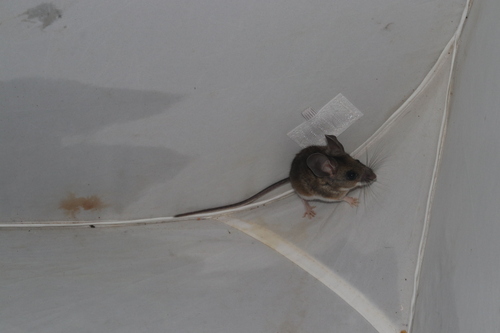
The Southern Rock Deermouse inhabits crags and volcanic outcrops in the mountains of central Mexico, a much more vertical habitat than that of most of its relatives in the genus Peromyscus. It gives its name to an entire group of Mexican mountain species, which mammalogists continue to redefine as new genetic studies emerge. In fact, several populations previously considered part of this species are now treated as distinct species.
The Southern Rock Deermouse is a medium-sized mouse, with a greyish-brown back and white belly, and a long, well-furred tail typical of rock mice. It differs from other species in the Peromyscus difficilis complex, with which it shares part of its mountainous home range. To the naked eye, it is practically identical to these species, differing mainly by craniometric and genetic features only assessable by direct comparison of specimens.
The Southern Rock Deermouse shelters in rock crevices and under loose stones within the volcanic outcrops it inhabits. It does not construct excavated burrows, unlike rodents found in softer ground. The most reliable sign of its presence is small accumulations of seeds and husks at the bottom of a rock crevice. Its tracks, tiny and very similar to those of other mountain Peromyscus species, do not allow reliable species-level identification. The strictly rocky habitat is more useful in the field than the tracks and signs themselves.
The Southern Rock Deermouse lives in rocky outcrops and mountain rock formations of central Mexico, at mid and high altitudes.
It feeds on seeds, fruits and invertebrates available in its rocky mountain environment.
It is nocturnal and solitary, its habits strictly tied to rock crevices and hollows for shelter and breeding.
Listed as Least Concern by the IUCN, with a wide distribution throughout the mountains of central Mexico.
The conversion of mountain slopes to agricultural use in some parts of its range can affect local populations, although its association with rocky terrain limits the direct impact of human development.
See all species accounts for rodents · Full species index
Mammaling is a free app for logging the mammals you find. You record a sighting in a moment — even if it's just a track — your life list grows, and the record becomes available to scientific and conservation projects.
It runs on your phone with nothing to install. If you like, it adds to your home screen like any other app.
Open Mammaling