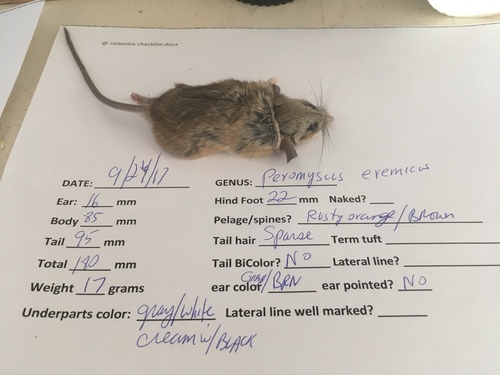
The Cactus Deermouse is one of the rodents best adapted to the extreme heat of North American deserts. It actively chooses the coolest spots in its home range, from rock crevices to the inside of a cactus, to reduce water loss through respiration. This thermoregulatory behaviour allows it to survive where other small mammals would not. It is also a good climber, able to ascend rock faces and mesquite trees to reach seeds that other ground-dwelling rodents cannot access.
It measures 16-21 cm in total length, with a long, sparsely haired tail similar in length to the body. Its fur is pale brown to greyish on the back and white on the belly.
Females are slightly larger than males.
The Cactus Deermouse differs from other desert Peromyscus, such as the Canyon Mouse, by preferring more varied refuges
The Cactus Deermouse digs its own burrows in loose soil, but also occupies abandoned burrows of other rodents, cactus hollows, piles of stone or wood, and even human constructions. Consequently, no single type of shelter serves to identify it.
Its tracks are tiny and difficult to reliably distinguish from those of other desert Peromyscus, making them of little use for field identification. The Cactus Deermouse has been observed foraging in mesquite trees 1-2 m high, an unusual behaviour among ground rodents. This can leave gnawed seeds on low branches as an indirect sign.
The Cactus Deermouse lives in deserts, arid scrubland, and rocky areas of the southwestern United States and much of Mexico, from sea level up to mid-mountain areas.
It feeds on seeds, fruits, and insects, supplementing its diet depending on seasonal availability in the desert.
It is nocturnal and solitary, with active thermoregulation behaviour: it selects cool microhabitats such as rock crevices, burrows or dense scrub to reduce heat stress and water loss.
Listed as Least Concern by the IUCN, with stable populations across most of its wide range in North America.
No significant threats have been documented at the species level; locally, the loss of desert habitat due to urban and agricultural expansion may affect specific populations.
See all species accounts for rodents · Full species index
Mammaling is a free app for logging the mammals you find. You record a sighting in a moment — even if it's just a track — your life list grows, and the record becomes available to scientific and conservation projects.
It runs on your phone with nothing to install. If you like, it adds to your home screen like any other app.
Open Mammaling