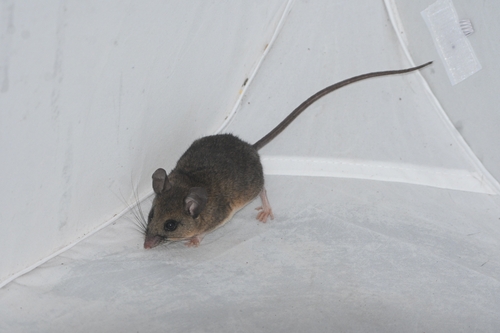
It has the belly tinted of a very characteristic yellow ocre tone, different from the pure white presented by most of its forest relatives, a detail that gives it a name and helps to differentiate it in hand. It lives in the cloudy forest and tropical mountain forest of a fringe in northeast Mexico, in the boundary between the states of San Luis Potosí and Tamaulipas, a climate transition area that houses a remarkable diversity of small mammals. Like the rest of mice of its genre, it is an opportunistic nocturnal forage that adapts to the availability of seasonal seed, fruit and invertebrate of the sotobosque.
Small rodent, gray brown coat on the back and belly of a characteristic yellow ocre tone, different from the pure white of other related species. It differs from other species of Peromyscus of northeast Mexico precisely by that ocre tone of the belly, a visible trait even at a glance in hand.
Small footprint, 1.3-1.8 cm, with 4 front fingers and 5 rear fingers. Small, lengthy excrete, 3-5 mm, left scattered by paths between the vegetation of the mountain sotobosque. Excavate dirty strawberries under roots, dropped trunks or rocks, with the semi-cultured entrance between the dense vegetation of the mist forest where you live.
A medium-mountain rainforest and rainforest, with dense sotobosque, generally between 800 and 2000 m of altitude.Distributed by a region of northeast Mexico, on the border between San Luis Potosí and Tamaulipas.
Omnivorous, it feeds on seed, fruit, fungus and invertebrates from the mountain subsoil where it lives.
Solitary and nightlife, with a campsite centered on the dense sotobosque of the mountain forest where it lives.
Its populations are considered to be declining due to the continued loss of the fog forest it depends on, transformed increasingly by the agricultural and livestock expansion in northeastern Mexico.
Deforestation and fragmentation of the fog and tropical mountain forest by agricultural and livestock expansion in San Luis Potosí and Tamaulipas.
See all species accounts for rodents · Full species index
Mammaling is a free app for logging the mammals you find. You record a sighting in a moment — even if it's just a track — your life list grows, and the record becomes available to scientific and conservation projects.
It runs on your phone with nothing to install. If you like, it adds to your home screen like any other app.
Open Mammaling