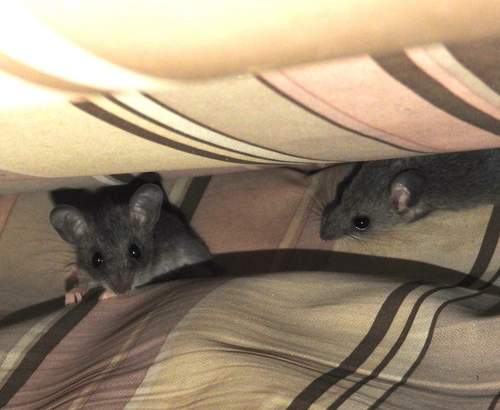
It lives in the coastal strip of north-western Mexico, between the states of Sinaloa and Nayarit, in a type of dry tropical forest that becomes virtually unrecognisable between the wet season, when it suddenly turns green, and the dry season, when a large proportion of the trees drop their leaves completely. Like the rest of the mice in its genus, the Sinaloan Deermouse adjusts its reproductive activity to this marked seasonality, concentrating most of its breeding in the months of highest food availability following the rains. It is one of several rodents endemic to Mexico's Pacific coast whose distribution, although somewhat wider than that of other neighbouring species, remains restricted to a relatively narrow coastal strip. Its scientific name, which means 'similar' in Latin, refers to its strong morphological similarity to other related species in the region.
Small rodent with greyish-brown fur on the upperparts and white on the underparts. Confused with other Peromyscus species from the Pacific coast of north-western Mexico, which often require genetic or cranial analysis for reliable separation given the strong morphological similarity between them all.
Small track, 1.3-1.8 cm long, showing 4 fore toes and 5 hind toes. Small, elongated droppings, 3-5 mm, left scattered along surface runways through dry tropical forest vegetation. It digs shallow burrows under roots, fallen logs or rocks, with the entrance semi-concealed among dense vegetation.
Coastal dry tropical forest in lowlands. Distributed along the Pacific coast of north-western Mexico, between the states of Sinaloa and Nayarit.
Omnivorous, feeding on seeds, fruit, fungi and invertebrates of the dry tropical forest, with strongly seasonal breeding linked to resource availability following the rains.
Solitary and nocturnal, with breeding behaviour closely tied to the marked seasonality of the dry tropical forest where it lives, concentrating its young in the months following the rains.
Its populations are considered to be in decline due to the ongoing loss of the coastal dry tropical forest on which it depends, which is increasingly converted by agricultural and tourist development along Mexico's north-western Pacific coast.
Deforestation and fragmentation of dry tropical forest through agricultural, livestock and tourist development on the Pacific coast of north-western Mexico.
See all species accounts for rodents · Full species index
Mammaling is a free app for logging the mammals you find. You record a sighting in a moment — even if it's just a track — your life list grows, and the record becomes available to scientific and conservation projects.
It runs on your phone with nothing to install. If you like, it adds to your home screen like any other app.
Open Mammaling