Found solely on a tiny island in the Gulf of California, Santa Catalina, an enclave so isolated that it has evolved its own community of unique species, including a rattlesnake world-renowned for lacking a functional rattle. It shares with that snake and other endemic island species the same fate: survival dependent entirely on a territory that can be crossed in a single day. Its name honours an American herpetologist and naturalist who documented much of the wildlife of the Gulf of California islands in the early 20th century. It is one of many examples of how these islands, despite their small size, harbour an endemic biodiversity disproportionate to their area.
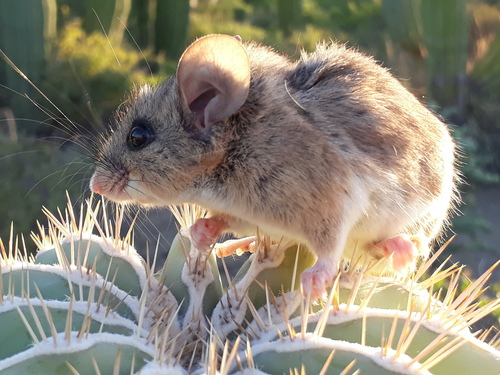
A small rodent with greyish-brown fur on the upperparts and white on the underparts, large eyes and well-developed ears. It differs from other species of Peromyscus in the Gulf of California by its exclusive restriction to Santa Catalina Island, with no overlap with any other island or mainland population.
Small track, 1.3-1.8 cm, showing 4 front toes and 5 hind toes. Small, elongated droppings 3-5 mm long, left scattered along surface runways through the island's arid scrub vegetation. It digs shallow burrows beneath rocks or roots, the entrance semi-hidden among dense vegetation.
Arid scrub on a desert island, in lowlands. Endemic to Santa Catalina Island in the Gulf of California, Mexico, with no natural presence outside this island.
Omnivorous, feeding on seeds, leaves and invertebrates from the arid scrubland of its island home.
Solitary and nocturnal, with a home range centred on shelters among rocks and dense vegetation on its island home.
Its restriction to a single, tiny island, combined with the constant threat of introduced predators such as cats, leaves its populations extremely vulnerable.
Risk of introduction of cats, rats or other predators to Santa Catalina Island, and the species' extreme geographical restriction to a tiny island territory.
See all species accounts for rodents · Full species index
Mammaling is a free app for logging the mammals you find. You record a sighting in a moment — even if it's just a track — your life list grows, and the record becomes available to scientific and conservation projects.
It runs on your phone with nothing to install. If you like, it adds to your home screen like any other app.
Open Mammaling