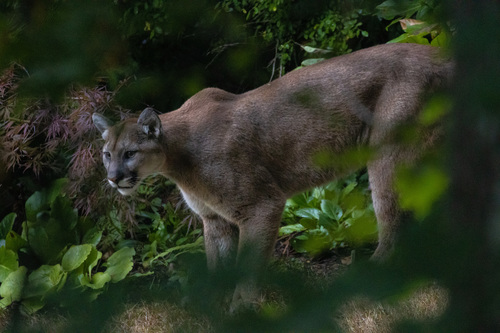
No other terrestrial mammal in the western hemisphere has such an extensive distribution area, from southern Canada to the southern extreme of South America, a range that crosses virtually all types of habitat in the American continent. Despite its large size, it can not roar: it belongs to the group of felines that roar rather than roar, and its vocal repertoire includes sinking, roaring and a sharp chill during zeal that surprises those who listen to it for the first time. It is also the mammal with the most common names distinct in its language, with dozens of regional denominations along its area, from puma and mountain lion to panther, according to the American region. Solitary and extremely territorial, a single adult male can need a campsite area of several hundred square kilometers in areas with fewer available presses
Large felino, of uniform fur brown red to grey without stains in the adult (children are born stained), small head in proportion to the body and long tail with the dark tip. It differs from the jaguar by lacking stains in the adult and by being more slimmer complexion, and from other felinos of smaller size of their area by their clearly larger size and that long and uniform tail.
Round footprint without nail marks, 7-9 cm, notably larger than that of a lynx or a mountain cat, with the pattern of straight line walking typical of large felines. Cylindrical and segmented feces, 8-12 cm, with hair and visible bone, often deposited without burial on elevated points as a territorial mark, unlike the wolf, which leaves them in crossings of more open paths. It partially covers its large prey with leafy and ground after feeding, returning to them in subsequent days, and leaves garlic marks on trunks used as sharp points and territorial marking.
Very varied, from forest and jungle to desert, grassland and mountain, from low lands to high heights close to the forest limit. Distributed from southern Canada to the southern extreme of South America, the widest distribution area of any terrestrial mammal of the American continent.
Carnivorous, hunting mainly serpent and other medium-sized ungulates where they are available, complemented with smaller prey according to the region.
Solitary and territorial, with males occupying very extensive field areas that overlap with those of several females.It does not have a fixed breeding period in most of its tropical area, and the offspring remain with the mother up to two years before independence.
Its populations are considered stable in much of its wide area of distribution, with a remarkable recovery in some regions of North America in recent decades, while in Central America and parts of South America it suffers local declines more marked by the loss of habitat.
Habitat fragmentation by infrastructure and agricultural expansion, road crashes, and conflict with livestock in some regions that leads to control hunting.
See all species accounts for carnivores · Full species index
Mammaling is a free app for logging the mammals you find. You record a sighting in a moment — even if it's just a track — your life list grows, and the record becomes available to scientific and conservation projects.
It runs on your phone with nothing to install. If you like, it adds to your home screen like any other app.
Open Mammaling