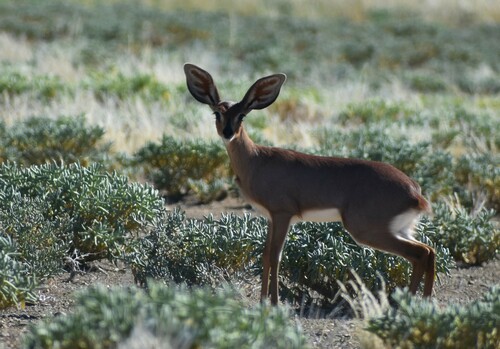
The Steenbok is one of Africa's smallest antelopes, barely taller than a medium-sized dog. It has developed a survival strategy uncommon among ungulates: instead of fleeing when threatened, it crouches flat to the ground under a bush and relies on remaining undetected. It also has a habit almost unique among antelopes: it digs a hole before defecating and covers it afterwards, a behaviour discreet even for relieving itself. It lives alone or in pairs that share a territory but rarely meet.
The Steenbok is a very small, slender antelope. It has uniform reddish-cinnamon fur, a white belly, and large, rounded ears. Only the male has short, straight horns.
It can be confused with other sympatric dwarf antelopes, but it is smaller than the Oribi and has proportionally larger ears than the Grey Duiker.
Small, pointed track, 2.5-3.5 cm long, with hooves held very close together. Droppings are tiny pellets 0.8-1 cm long. The Steenbok usually buries them by digging a small hole before defecating and then covering it, a behaviour uncommon among antelopes. When startled, it runs in a zigzag pattern and crouches low to the ground under a bush instead of fleeing far away.
Open savanna and dry bushland with short grass and scattered shrub cover, from lowlands to high plateau. Distributed in two separate areas of sub-Saharan Africa: East and Southern Africa, with a gap in the central region.
Mixed browser and grazer: leaves, shoots, fruits, and tender grass. It can go for long periods without drinking water, obtaining it from vegetation.
Solitary or in pairs sharing a territory but moving separately; highly territorial, marking with piles of buried droppings and secretions from preorbital glands. No fixed breeding season in much of its range.
The Steenbok maintains large and well-represented populations within and outside protected areas throughout most of its distribution, with no signs of widespread decline.
Habitat loss due to agricultural expansion in some areas and bycatch in traps set for other species, without significant global threats.
See all species accounts for even-toed ungulates · Full species index
Mammaling is a free app for logging the mammals you find. You record a sighting in a moment — even if it's just a track — your life list grows, and the record becomes available to scientific and conservation projects.
It runs on your phone with nothing to install. If you like, it adds to your home screen like any other app.
Open Mammaling