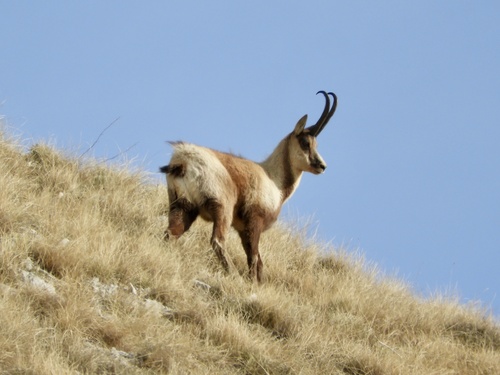
The Southern Chamois is the tightrope walker of south-western European peaks, capable of leaping several metres between rock ledges separated by precipices, barely pausing to calculate the distance. This makes its movement through the mountains an almost routine acrobatic feat.
Although sharing a single scientific name, Rupicapra pyrenaica actually comprises three very distinct populations, each distributed across a separate mountain range. Each is treated as its own subspecies and has a completely different conservation history. One of these was on the verge of disappearing entirely barely a century ago and is now one of Europe's best-documented examples of mountain fauna recovery.
Its pelage changes with the seasons, from a light brown coat in summer to a much darker, denser one in winter, which provides insulation against the cold of the high mountains.
A medium-sized bovid with a reddish-brown coat in summer, which darkens to almost blackish-brown in winter. It has a characteristic dark stripe running along its back and a dark facial mask contrasting with a pale face. Both sexes have slender horns, curved backwards and hooked at the tip. These are much finer than those of the Iberian Ibex, and are present in females, unlike that
Tracks are similar to those of a small domestic goat, 4-5 cm long, narrow and pointed, with the two hooves very close together. They are clearly marked on fine dusty rock or snow.
Droppings are oval pellets, 0.8-1.2 cm long, grouped in piles on ledges and flat areas repeatedly used as resting places.
Southern Chamois leave very marked trails traversing high mountain slopes. During the rut, males leave visible pursuit and combat marks in low vegetation. They also use a characteristic nasal snort as an alarm signal in the presence of an intruder.
High mountains, from subalpine forest to alpine grassland and rocky areas above the treeline, with seasonal altitudinal movements depending on pasture availability and winter severity. Distributed in three isolated populations, each treated as its own subspecies: the Pyrenees, the Cantabrian Mountains and the central Apennines, in southern Europe.
Herbivorous, it feeds on grass, woody shoots, lichen, and leaves depending on seasonal and altitudinal availability. In winter, it descends to lower altitudes when high-altitude pasture is covered in snow.
The Southern Chamois lives in sex-segregated groups for most of the year. Females and young form herds, while adult males are more solitary outside the autumn oestrus, when they compete for access to females. It makes regular seasonal altitudinal movements between high-altitude summer areas and lower-altitude winter refuges.
The Apennine subspecies was on the brink of extinction at the beginning of the 20th century, reduced to a handful of individuals. It has since recovered remarkably thanks to decades of strict protection, reaching several thousand individuals. The Pyrenean and Cantabrian populations remain generally numerous and stable, although they suffered significant localised mortalities due to outbreaks of keratoconjunctivitis and sarcoptic mange in recent decades.
Periodic outbreaks of infectious disease, such as kerato-conjunctivitis or mange, which can cause localised mass mortalities; competition with domestic livestock for high-mountain pasture; and, in the Apennine subspecies, the reduced genetic base inherited from the historical bottleneck.
See all species accounts for even-toed ungulates · Full species index
Mammaling is a free app for logging the mammals you find. You record a sighting in a moment — even if it's just a track — your life list grows, and the record becomes available to scientific and conservation projects.
It runs on your phone with nothing to install. If you like, it adds to your home screen like any other app.
Open Mammaling